Author: Lun Cai DELIECN
Introduction
In many manufacturing plants, cast parts produced in workshops are often irregular in shape and need to be placed on specially designed pallets. These parts are traditionally classified, transported, and stacked in designated areas by operators using forklifts. Inventory is often recorded manually.
For large and heavy tractor castings, such as engine housings and transmission housings, this traditional method creates several challenges. When forklifts are used to stack heavy parts at height, safety risks increase significantly. Manual handling may also damage high-value castings. At the same time, manual inventory records often lack accuracy and real-time visibility.
Another common issue is low space utilization. Since cast housing parts are usually stacked in dedicated floor areas, warehouse height is not fully used, and turnover efficiency is limited.
To solve these problems, the implementation of an automated storage and retrieval system becomes an urgent requirement. By automating material handling, cleaning-line connection, inbound and outbound operations, and storage management, manufacturers can improve warehouse turnover, enhance operational safety, reduce operating costs, and realize more intelligent, automated, and lean warehouse management.

1. Overview of the Cast Housing Parts Storage System
Cast housing parts, including engine housings and transmission housings, are generally large, heavy, and high-value components. Manual forklift handling brings high operational risk and heavy labor intensity. Traditional storage methods also result in large floor occupation, low turnover efficiency, and limited inventory visibility.
For this reason, the project required an automated and intelligent high-bay storage system that could handle multiple product types and different part dimensions.

The system mainly included the following hardware:
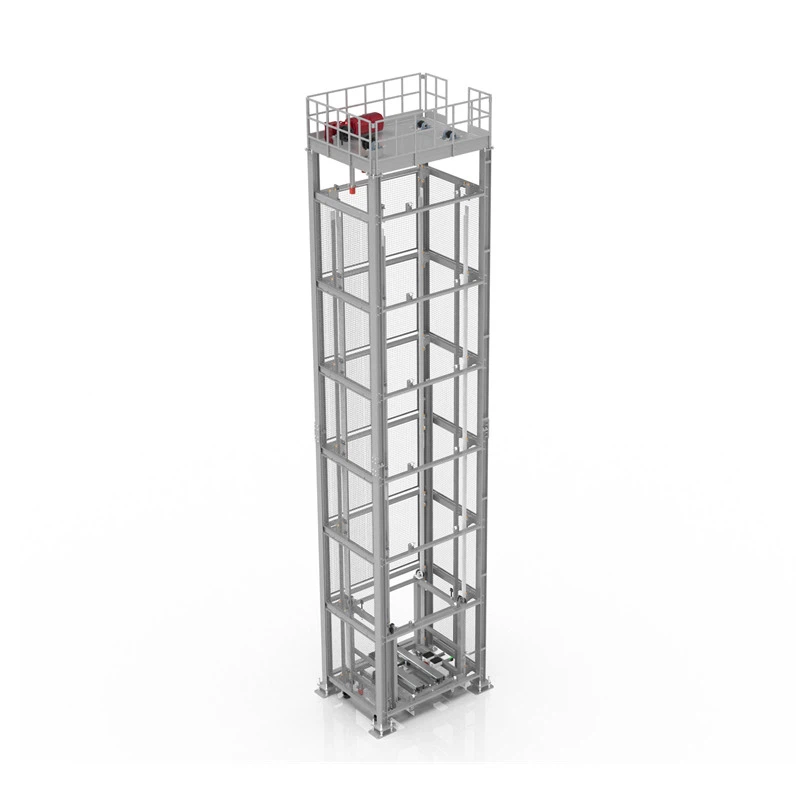
2 rack aisles with 1,000 storage locations 2 single-deep stacker cranes 1 conveyor system 1 safety fencing system 1 lifting system 1 AGV handling system 1 automatic cleaning machine 4 gantry robot systems 1 automatic marking machine 1 electrical control system 1 warehouse management system
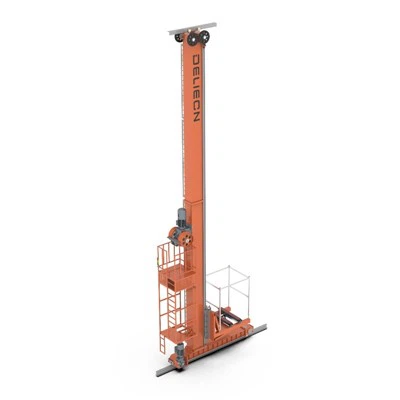
Considering the particular handling requirements of cast housing parts, the project adopted double-column stacker cranes to improve mechanical stability and operational reliability.
The stacker cranes use vector closed-loop variable-frequency control. This enables high-speed operation while reducing the risk of load instability. The lifting mechanism uses a brake-equipped spiral bevel gear motor reducer to directly drive the drum, with steel wire ropes driving the load platform up and down.
Both fixed pulleys and movable pulleys are made of engineered nylon. This hoisting method reduces noise, supports easier maintenance, and makes potential risks such as wire rope breakage easier to inspect visually. The wire rope is designed with a safety factor of 10, and the customized high-strength steel wire rope can operate safely for 4 to 6 years.
The lifting system is also equipped with overspeed braking and detection devices, bringing lifting safety and reliability close to elevator-grade standards.
2. Integrated AGV Handling and Process Connection
The system uses underride AGVs at the warehouse entrances, exits, and key workshop interfaces. Their main function is to automatically connect operators, production processes, cleaning lines, and the automated warehouse.
During inbound operation, operators place cast housing parts onto pallets. AGVs then transport the pallets to the automatic marking area. A gantry robot picks the workpiece and transfers it to the marking machine. After marking, the part is turned over by a turning machine. The gantry robot then places it onto an empty pallet supplied by the AGV.
The AGV transports the pallet to the semi-finished goods buffer area. When the production line requires materials, the AGV delivers the pallet to the machining workshop. After machining, the AGV transfers the part to the cleaning area. Once cleaning is completed, the AGV moves the pallet to the inbound lifting conveyor of the automated warehouse.
The pallet is then automatically transferred to the designated location, where the stacker crane picks it up and stores it in the assigned rack position.
During outbound operation, the stacker crane retrieves the pallet and places it onto the conveyor. The pallet is then transferred to the exit area and waits for the AGV to deliver it to the assembly workshop.
3. Software Architecture: WMS, WCS and RCS
The software system consists of three main parts:
Warehouse Management System, WMS Warehouse Control System, WCS AGV Robot Control System, RCS
Through these systems, the warehouse can plan storage locations, define process nodes, improve handling and storage efficiency, and record the full operation history of each part.
The system can track production status, assembly status, inbound status, outbound status, and inventory changes in real time. It can also connect with ERP, MES, and downstream receiving management systems.
By integrating WMS, WCS, and RCS, the system provides task routing, improves picking efficiency and accuracy, and ensures higher production efficiency across the entire manufacturing process.
4. Key Problems Solved by the Automated Storage System
Traditional storage of cast housing parts usually faces four major problems.
4.1 Low pallet standardization
Because cast housing parts vary in size and shape, traditional pallets are often designed for specific parts only. Different part types require different pallets, which reduces pallet flexibility and increases management complexity.
4.2 Low vertical space utilization
In traditional factories, manual forklifts are used for handling and stacking. Due to safety limitations and forklift lifting height restrictions, pallets cannot be stacked too high. At the same time, wide forklift aisles, often more than 4.2 meters, must be reserved, resulting in inefficient use of warehouse space.
4.3 Limited automation
Traditional cast housing part storage areas are often marked on the floor. Handling is completed by operators using electric pallet stackers or forklifts. Pallet stacking and destacking require manual operation.
This process is time-consuming and labor-intensive. It also increases safety risks for workers and makes it difficult to guarantee first-in, first-out operation.
4.4 Low information visibility
Inbound, outbound, in-storage management, and quality attribute identification often depend on worker experience and paper-based records. This creates heavy data management workload and makes it difficult to quickly and accurately reflect warehouse status. Errors and information loss can easily occur.
5. Design Measures and System Improvements
To solve these problems, the project adopted several key design measures.
First, the pallet design was standardized as much as possible to reduce pallet variety and improve compatibility across different cast housing parts.
Second, the rack structure was designed as the main storage carrier for cast housing pallets. To balance compatibility and efficiency, two rack size specifications were used, allowing the system to accommodate different types of cast housing parts.
Third, a four-level automated storage system was built to maximize the use of vertical space.
Fourth, AGV handling equipment was introduced to reduce the floor area required for logistics channels.
Fifth, WMS and WCS were applied to automate the entire storage process. The software controls equipment operation, monitors logistics information in real time, and automatically records inventory data. Parts can be stored and retrieved automatically, while inventory information is updated in the system in real time.
The system also connects with machining stations and assembly stations to support first-in, first-out management.
During inbound operation, operators use a PDA to request an empty pallet. The material barcode printed by the laser marking machine is then bound with the pallet information. Under unmanned operation, the automated storage system connects the production workshop, cleaning workshop, and assembly workshop.
The WMS automatically assigns storage locations according to product type. Once the pallet is transported to the assigned position, inventory information is automatically recorded. During outbound operation, the specified pallet is retrieved from the automated warehouse, and the system automatically deducts the corresponding inventory.
6. Workflow of the Cast Housing Parts Storage System
6.1 Semi-finished goods inbound and finished goods delivery to cleaning line
Semi-finished cast parts are produced in the casting workshop and transported by forklift to the semi-finished goods buffer area.
The gantry robot picks the semi-finished workpiece and transfers it to the turning machine. Operators use a handheld PDA to scan the workpiece barcode and confirm the information. The system then creates a QR code containing finished product information according to the MES production order.

The workpiece information and finished product information are bound through the PDA and uploaded to the MES system. The turning machine flips the semi-finished part so that the process reference surface faces downward. The gantry robot then places the part onto the turnover pallet on the AGV docking rack.
After two parts are loaded onto one pallet, the system automatically binds the workpieces with the pallet information.
If the parts are semi-finished goods, the WMS assigns a docking position in the buffer rack area. The WCS then dispatches the AGV to transport the pallet into storage. The WMS completes the inbound operation and synchronizes data with the MES.
If the parts are finished goods, the AGV transports the pallet to the cleaning machine inbound docking position, and the WMS dispatches the AGV to execute the handling task.
6.2 Semi-finished goods delivery to production line
The WMS receives material demand plans from the MES or call-off requests from line operators through PDA.
The WMS generates a handling task, and the WCS dispatches the AGV to transport materials from the buffer area to the production line feeding point. The WMS completes the outbound operation and synchronizes the data with the MES.
6.3 From production line to cleaning machine
After finished machining, the WMS generates a handling task. The WCS dispatches the AGV to transport the pallet to the cleaning machine docking position.
The housing part then enters the cleaning machine conveyor line for cleaning.
6.4 From cleaning machine to automated warehouse
After cleaning, the WMS generates a handling task. The WCS dispatches the AGV to transport the pallet from the cleaning machine unloading point to the automated warehouse inbound docking point.
6.5 Finished goods inbound to automated warehouse
The AGV transfers the pallet to the warehouse conveyor and lifter. After profile inspection and barcode identification, the WMS generates an inbound task.
The WCS dispatches the stacker crane to transport the pallet to the assigned rack location. The WMS completes the inbound operation and synchronizes the data with the MES.
6.6 Finished goods outbound from automated warehouse
The WMS receives an outbound request from the MES or PDA and generates an outbound task.
The WCS dispatches the stacker crane to retrieve the pallet and transfer it to the warehouse exit. The WMS completes the outbound operation and synchronizes the data with the MES.
The gantry robot then destacks the parts, and the housing base is connected with the assembly tooling plate. Finally, the AGV transports the parts to the assembly workshop.
7. Safety Measures and Emergency Protection
The electrical control cabinet is placed against the wall in the automated warehouse area, with a reserved personnel safety passage for operation and maintenance.
The control cabinet is equipped with a touch screen, key switch, function indicators, fault indicators, and buzzer alarm. It is operated by trained technical personnel only.
When the stacker crane is in online automatic control mode, it operates automatically according to WCS commands without manual intervention.

To ensure personnel and equipment safety, the system includes the following protection measures:
Complete hardware and software safety protection for all mechanical equipment Electrical interlocking and safety protection in the control system Travel, lifting, and fork-extension limit photoelectric sensors Forced deceleration for travel, lifting, and fork-extension movements Real-time empty/full location detection on the stacker crane load platform Profile detection at the entrance to prevent mismatched load dimensions Overload and slack-rope protection for the lifting mechanism Human-machine separation in the AGV operating area Reserved pedestrian safety passages Three-color indicator lights for single machines and conveyor equipment
When the load on the platform exceeds 1.5 times the rated load, or when the wire rope loses tension, the lifting mechanism stops immediately to ensure safe operation.
8. Project Results
Since its implementation, the cast housing parts storage system has successfully realized automated production connection, cleaning-line connection, assembly connection, storage, inbound operation, and outbound operation.
The project achieved the following results:
Reduced manual handling Improved automated logistics efficiency Reduced high-altitude stacking operations Enhanced operational safety Reduced deformation caused by manual pallet collision Improved protection of pallets and product accuracy Enabled automated connection between workshops and processes Improved space utilization Solved the problem of limited storage area
The system connects workshop machining, cleaning, automated handling, automatic conveying, automatic destacking, and automated warehouse inbound and outbound operations.
It improves logistics efficiency between workshops and processes, increases automation level, reduces labor cost, and creates greater operational value for the manufacturer.
Conclusion
Warehouse automation is not only a key part of industrial modernization, but also an important driver of manufacturing upgrading and operational efficiency.
For large, heavy, and irregular cast housing parts, traditional manual handling and floor-based storage are no longer sufficient. An automated storage system integrated with stacker cranes, AGVs, conveyors, gantry robots, WMS, WCS, and MES can significantly improve safety, storage density, logistics efficiency, and inventory visibility.
As automation technology continues to mature, and as IoT, intelligent control, and digital warehouse systems become more deeply integrated, automated storage solutions will create greater value across manufacturing industries.
For companies seeking safer handling, higher space utilization, faster workshop logistics, and more accurate inventory management, automated storage systems provide a reliable path toward smarter and leaner operations.