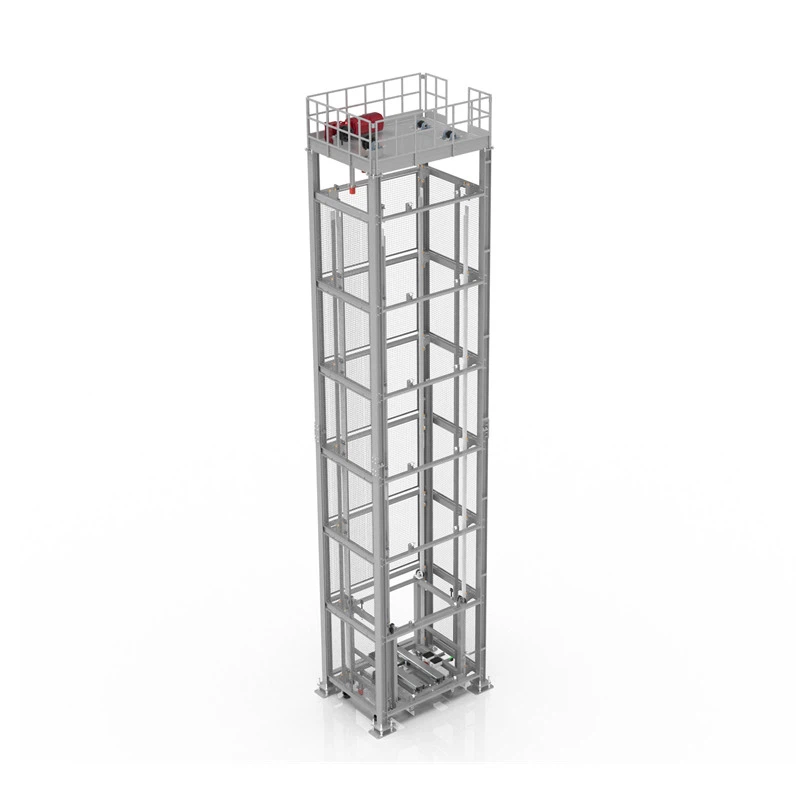
Athor: RongChuan Yang DELIECN
Introduction
As factories expand, many manufacturers are considering the introduction of automated storage and retrieval systems to improve storage efficiency and reduce floor space. However, before deciding whether to build an AS/RS, it is necessary to clearly understand its value and conduct a feasibility analysis to ensure that the project is both necessary and practical.
This report analyzes the feasibility of an automated warehouse project from five perspectives: the value of AS/RS, standardization work, technical requirements, business requirements, and cost.
1. Value of an AS/RS
1.1 Reducing Forklift Use
After introducing an AS/RS, inbound and outbound operations are mainly completed by stacker cranes. Goods can be transferred to the designated area automatically, reducing dependence on forklifts.
As a result, forklift usage can be significantly reduced, lowering forklift maintenance costs and labor costs. At the same time, fewer forklifts operating inside the warehouse also reduce traffic time and accident risks.
1.2 Reducing Floor Space
An AS/RS uses vertical storage to fully utilize warehouse height. Compared with a conventional flat warehouse, an AS/RS can maximize storage capacity and save land resources.
1.3 Improving Inventory Turnover and Inbound/Outbound Efficiency
Through automated stacker cranes and conveyor systems, an AS/RS can complete inbound and outbound operations more efficiently.
Goods can be stored and retrieved quickly and accurately, improving inventory turnover and logistics efficiency. The system can also automatically dispatch goods according to demand, reducing waiting time and handling time.
1.4 Saving Labor
An AS/RS has a high level of automation and requires only a small number of personnel for monitoring and maintenance.
Compared with traditional manual operations, it can greatly reduce labor input and labor cost. The factory can allocate human resources to more valuable work, improving overall production efficiency and competitiveness.

1.5 Supporting Refined Management
An AS/RS is equipped with advanced warehouse management software, enabling accurate management and tracking of goods.
Through real-time monitoring and data analysis, the factory can understand inventory status, goods flow, and overall warehouse operations. This supports refined management, timely adjustment, and supply chain optimization.
1.6 Reducing Safety Risks
An AS/RS uses automated equipment for loading, unloading, storage, and retrieval, reducing direct human involvement in material handling.
This reduces contact between operators and goods and lowers the risk of accidents. In addition, the system is equipped with safety devices such as safety doors and sensors to detect and prevent potential risks.
2. Standardization Work
Business processes, operating procedures, and documents have already been standardized, but further software standardization is still required.
Software standardization is an important step to ensure the stability and efficient operation of the AS/RS. Corresponding software standards should be established to ensure system consistency and maintainability.
2.1 Business Standardization
1)AS/RS Design Standards
In AS/RS design, factors such as cargo type, size, capacity, and weight should be considered. Unified design standards should be established to ensure reasonable inventory layout and effective space utilization.
2)Storage Standards
Standards should be defined for storage locations and storage methods, so that goods can be located and retrieved quickly.
3)Inbound and Outbound Operation Standards
Inbound and outbound workflows and operating requirements should be clearly defined, including operation procedures, inspection standards, and document completion requirements.
4)Inventory Management Standards
A reasonable inventory management system should be established, including stocktaking, exception handling, and replenishment mechanisms, to improve inventory turnover and reduce inventory cost.
2.2 Process Standardization
1)AS/RS Construction Process
The construction process, stages, and responsible persons should be clearly defined, including feasibility study, solution design, equipment procurement, installation, and commissioning.
2)Inbound and Outbound Process
Inbound and outbound workflows should be standardized, with clear operating procedures and job responsibilities to ensure accuracy and coordination at each step.
3)Operating Process
Standard operating procedures should be defined for loading, unloading, handling, and storage to reduce operating errors and safety risks.
2.3 Document Standardization
1)Design Documents
Detailed AS/RS design documents should be prepared, including warehouse layout drawings, structural design, and equipment selection, to support future maintenance and modification.

2)Operation Manual
An operation manual should be prepared, covering inbound and outbound procedures, operating standards, and safety precautions. This will support training for new employees and daily operational reference.
3)Records and Reports
A complete record and reporting system should be established, including inbound and outbound records, inventory reports, and exception handling records. These documents provide a basis for daily management and decision-making.
3. Business Requirement Analysis: Case Example
3.1 Project Requirements
The project requirements are as follows:
| Item | Requirement |
|---|---|
| Site size | 72,000 × 32,000 × 13,500 mm |
| Goods type | Finished products |
| Packaging type | Boxed and bagged products |
| SKU quantity | 300 SKUs |
| Pallet rule | One SKU per pallet, no mixed pallets |
| Goods size, including pallet | 1.35 × 1.35 × 1.5 m |
| Weight per pallet | 500 kg |
| Maximum storage demand | 3,700 storage locations |
| Safety stock cycle | 15 days |
| Operating time | 6 hours/day |
| Inbound/outbound flow | 80 pallets/hour |
3.2 AS/RS Solution
Based on the design, the final number of storage locations was determined as 3,744 pallet positions, with a 6-level rack design.
This can meet a safety stock cycle of approximately 15 days.
3.3 Conventional Flat Warehouse Solution
In the conventional flat warehouse solution, the maximum available floor area of the project is:
72 m × 32 m = 2,304 m²
After deducting forklift aisles and receiving/shipping areas, the flat warehouse can provide 1,600 pallet positions with a 4-level stacking design.
The inventory capacity is calculated as:
800 tons ÷ 120 tons/day = 6.7 days
By comparison, the AS/RS can store goods for 15 days, while the flat warehouse can only store goods for 6.7 days.
This creates significant inventory pressure and is not favorable for production stability or effective product storage.
If the same number of storage locations were to be achieved without an AS/RS, the warehouse area required would be 5,158 m². Therefore, the AS/RS can save 2,854 m² of land and maximize the use of limited resources.
From the perspective of safety stock capacity, the flat warehouse capacity of 6.7 days cannot meet normal production needs. The AS/RS can solve the problem of warehouse overflow by supporting 15 days of inventory.
4. Technical Requirement Analysis
4.1 System Management Software
1)Cost Analysis
The AS/RS project uses WMS and WCS for management.
WMS refers to the Warehouse Management System, and WCS refers to the Warehouse Control System.
By using WMS and WCS, the factory can reduce the number of personnel required for picking goods or searching for non-conforming products. To achieve an inbound and outbound flow of 80 pallets/hour, at least four workers can be saved.
2)Management Analysis
The AS/RS management system supports centralized information management and unified dispatching.
It also allows personnel to view warehouse information more conveniently, including inventory status and inbound/outbound flow. This makes warehouse operations more transparent and easier to manage.

5. Cost Analysis
5.1 Fixed Investment Cost Analysis
1)Building Cost
The warehouse floor area is:
72 m × 32 m = 2,304 m²
The building cost of a conventional flat warehouse is calculated at RMB 1,000/m².
The building cost of an AS/RS warehouse is calculated at RMB 2,750/m².
Therefore:
| Item | Calculation | Cost |
|---|---|---|
| Flat warehouse building cost | 5,158 × 0.10 | RMB 5.158 million |
| AS/RS warehouse building cost | 2,304 × 0.275 | RMB 6.336 million |
2)Land Cost
Compared with the AS/RS solution, the flat warehouse requires more land.
Additional land cost:
RMB 150,000/mu × (5,158 - 2,304) ÷ 666.67 = RMB 642,000
3)Equipment Cost
For the flat warehouse, according to Section 5.2, four 3-ton electric forklifts and RMB 600,000 of racking are required. The total equipment cost is approximately RMB 1.2 million.
For the AS/RS, the preliminary quotation is RMB 6.2 million. The AS/RS solution also requires two 3-ton electric forklifts, with forklift equipment cost of approximately RMB 300,000.
Therefore:
| Solution | Fixed Investment |
|---|---|
| Flat warehouse | 5.158 + 1.20 = RMB 6.358 million |
| AS/RS | 6.336 + 6.20 + 0.30 = RMB 12.836 million |
Conclusion:
In terms of fixed investment, the AS/RS requires RMB 6.478 million more than the flat warehouse.
Note: The original Chinese text says "AS/RS invests RMB 6.478 million less," but based on the calculation, it should be "more," not "less."
5.2 Operating Cost Analysis
1)Inbound Analysis
For the flat warehouse, one forklift operated by one person can handle about 20 pallets/hour. To complete an inbound flow of 40 pallets/hour, two forklifts are required.
For the AS/RS, one manual forklift is required for inbound operation.
2)Shipping Analysis
For the flat warehouse, one forklift operated by one person can handle about 20 pallets/hour. To complete an outbound flow of 40 pallets/hour, two forklifts are required.
For the AS/RS, one manual forklift is required for outbound operation.
In summary:
| Solution | Forklifts | Workers |
|---|---|---|
| Flat warehouse | 4 forklifts | 4 workers |
| AS/RS | 2 forklifts | 2 forklift operators + conveyor system |
Table 5.1 Cost Calculation Standards
| Cost Item | Labor Cost | Energy Cost | Maintenance Cost | Forklift Cost |
|---|---|---|---|---|
| Standard | RMB 100,000/person/year | RMB 0.4/kWh | 2.5% of equipment investment | RMB 150,000/unit |
The battery model for the 3-ton electric forklift is 80V412Ah-4. If it runs for 7–8 hours per day, it needs to be recharged once per day.
Therefore:
Flat warehouse forklifts need to be charged 4 times per day.
AS/RS forklifts need to be charged 2 times per day.
Each charging cycle consumes approximately:
80 × 412 ÷ 1000 = 33 kWh
Electricity price is calculated at RMB 0.4/kWh.
The AS/RS is equipped with 4 stacker cranes and some roller conveyors, with a total installed power of about 180 kW. The hourly power consumption is about 135 kWh.
Operating Cost of the Flat Warehouse
Labor cost:
10 × 4 = RMB 400,000/year
Energy consumption:
33 × 4 × 0.4 × 300 ÷ 10,000 = RMB 15,840/year
Equipment maintenance:
120 × 0.025 = RMB 30,000/year
Total operating cost:
40 + 1.584 + 3 = RMB 445,840/year
Operating Cost of the AS/RS
Labor cost:
2 × 10 = RMB 200,000/year
Energy consumption:
33 × 2 × 0.4 × 300 ÷ 10,000 + 135 × 0.4 × 6 × 300 ÷ 10,000 = RMB 97,200/year
Equipment maintenance:
650 × 0.025 = RMB 162,500/year
Total operating cost:
20 + 9.72 + 16.25 = RMB 459,700/year
Therefore, the AS/RS operating cost is higher than the flat warehouse by:
45.97 - 44.584 = RMB 13,860/year
3)Equipment Residual Value Analysis
Forklifts and palletizing line residual value are calculated at 10%.
The AS/RS uses about 200 tons of carbon steel, and the recycling price of carbon steel is calculated at RMB 2,000/ton.
| Solution | Residual Value |
|---|---|
| Flat warehouse | 120 × 0.1 = RMB 120,000 |
| AS/RS | 30 × 0.1 + 200 × 0.20 = RMB 430,000 |
4)Depreciation Analysis
Buildings are depreciated over 30 years.
Equipment is depreciated over 10 years.
Using the straight-line method:
Annual depreciation = (Original value - Estimated net residual value) ÷ Useful life
Flat warehouse annual depreciation:
515.8 ÷ 30 + (120 - 12) ÷ 10 = RMB 279,900/year
AS/RS annual depreciation:
633.6 ÷ 30 + (650 - 43) ÷ 10 = RMB 818,200/year

6. Economic Benefit Analysis
6.1 Total Fixed Investment
| Solution | Fixed Investment |
|---|---|
| Flat warehouse | RMB 6.358 million |
| AS/RS | RMB 12.836 million |
6.2 Annual Operating Cost
Table 6.1 Operating Cost Summary of Flat Warehouse and AS/RS
| Operating Cost | Depreciation | Labor | Energy | Maintenance | Total |
|---|---|---|---|---|---|
| Flat warehouse | 27.99 | 40 | 1.584 | 3 | 72.574 |
| AS/RS | 81.82 | 20 | 9.72 | 16.25 | 127.79 |
Unit: RMB 10,000
6.3 Comprehensive Cost Over 15 Years
Table 6.2 15-Year Comprehensive Cost Summary
| Solution | Fixed Investment | Operating Cost | Equipment Residual Value | Total Cost |
|---|---|---|---|---|
| Flat warehouse | 635.8 | 668.75 | -12 | 1292.55 |
| AS/RS | 1283.6 | 689.55 | -43 | 1930.15 |
Unit: RMB 10,000
Note:
Total cost = Fixed investment + Operating cost - Equipment residual value
Operating cost = (Labor + Energy + Maintenance) × Years
Based on the cost analysis, the 15-year cost of the AS/RS is approximately RMB 19.3015 million, while the 15-year cost of the flat warehouse is approximately RMB 12.9255 million.
Compared with the flat warehouse, the AS/RS does not have a direct cost advantage under this calculation model and costs RMB 6.376 million more.
7. Summary
7.1 Safety Stock Perspective
From the perspective of safety stock, the flat warehouse capacity of 6.7 days cannot meet normal production requirements.
The AS/RS can support 15 days of inventory, solving the problem of insufficient storage capacity. It also provides clear advantages in refined management and safety improvement, playing an important role in modern factory warehouse management.
7.2 Cost Perspective
For this project, the AS/RS solution does not have an advantage in either fixed investment or operating cost.
Based on a 15-year operating period, the AS/RS requires an additional cost of approximately RMB 6.376 million compared with the flat warehouse.
7.3 Warehouse Rental Perspective
However, if the customer must meet the required safety stock capacity through external warehouse rental, the result changes significantly.
Assuming the warehouse rent is RMB 5 per pallet position per day, and the warehouse is rented for 300 days per year, the annual rental cost is:
(3,744 - 1,600) × 5 × 300 ÷ 10,000 = RMB 3.216 million/year
From this perspective, the AS/RS has a significant advantage.