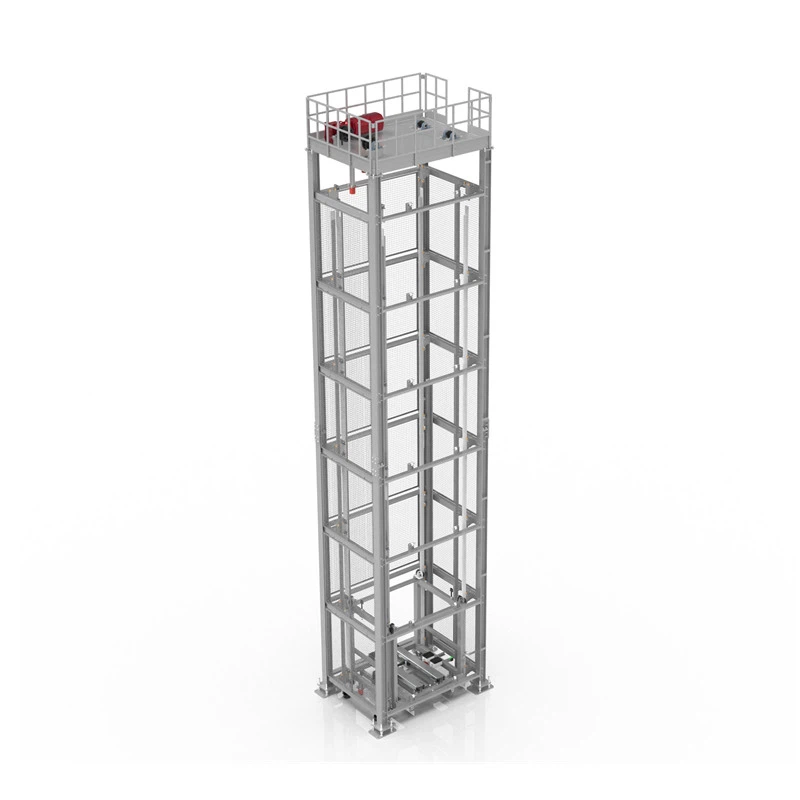
SHANGHAI, October 16 - CIIF 2026 came to a close with robots of many kinds having competed for attention across the exhibition halls. At the DELIECN booth, Mini-FlyBox gave visitors a reason to pause: running at 3.5 m/s, it travelled smoothly through the demonstration rack, drawing people closer to watch and take photographs.
Then came the questions. How much could it carry? Would it suit a component warehouse? What would a complete installation cost?One visitor from Poland wanted to understand something more specific. Having watched the robot retrieve a tote, they wanted to know how that tote would reach the person who needed its contents.
Following the Tote Out of the Rack
The Polish customer described a distribution centre with 3,000 m² of floor space and a building height of 9 m. Picking was still manual. Walking to locations and finding goods took time, and the customer was looking for a more efficient arrangement.
Their questions went to the heart of goods-to-person picking. Retrieving a tote from a rack is only part of the job. It must reach a workstation, be available when the picker needs it, and return to storage afterwards.Mini-FlyBox brings the selected tote to a transfer point at the first rack level. From there, a tote AMR can carry it to the workstation. Conveyors are another option where a fixed connection suits the site. After picking, the tote returns by the connected equipment, and Mini-FlyBox puts it back into storage.For that customer, the important change would be in the picker's daily work. Instead of travelling between shelves for successive items, the operator could pick from totes arriving at a workstation.
A 9 m-high building sits comfortably within the Mini-FlyBox application range of under 12 m. The manual picking workload also made the Polish centre a promising fit. The next discussion would need order data: how many lines arrive at peak times, how often stock is replenished, and how quickly each station can process a tote. Those figures determine how many robots and transfer movements the operation needs.

Why a Component Warehouse Also Fits
A South Korean visitor was at an earlier stage. Their company was planning an automated component tote warehouse and asked whether Mini-FlyBox could be considered.
Yes: the system is designed for lightweight tote handling with loads up to 50 kg. Components that can be stored in suitable totes fall within its intended uses, subject to checking the containers and loads.
Component stores pose a particular space problem. A large number of part numbers can require many separate locations, even when the quantity held for each is modest. Leaving enough room for people to reach all those locations takes up floor area and adds travel to every picking round.
Mini-FlyBox incorporates its travel rails into the racking. Horizontal movement and vertical level changes take place within the rack frame, with aisles as narrow as 860 mm. This makes it possible to arrange tote locations closely while retaining automated access.
Depending on the existing storage method and the new layout, capacity can reach 3–10 times that of conventional storage. For the Korean project, the useful calculation would be the number of tote locations achievable with the actual component containers, rather than applying that range directly to the building area.

The Price Question Deserved More Than a Robot Quotation
An American visitor asked about the price of the whole system. It is a reasonable place to begin: a buyer needs to know what the proposed change will cost.But the robot alone would make an incomplete quotation. Racking, storage locations, software, installation and after sales service all belong in the scope. A layout using conveyors will have different costs from one using AMRs. Two warehouses holding the same number of totes may also need different equipment quantities if their peak workloads differ.The integrated structure gives Mini-FlyBox a useful starting point economically. Dense storage can reduce the floor area needed for a given inventory, while goods-to-person picking cuts journeys through the warehouse. Whether those changes produce an attractive return depends on the operation: ending an overflow lease, reducing overtime or handling growth with existing staff each has a different financial value.
An efficiency improvement of around 80% is possible depending on the application and original workflow. During planning, that needs to become a concrete target for completed work, with workstation and transport capacity included.
A Reference Already Handling Automotive Parts
For visitors asking about installations beyond the booth, DELIECN could point to a Toyota automotive spare parts centre. Its small-parts area uses 18 Mini-FlyBox robots, provides more than 17,000 tote locations and has a handling capacity of 870 order lines per hour.
Mini-FlyBox uses a conductor rail power supply, supporting 24/7 operation without battery-charging stops. Maintenance remains part of the operating schedule.
The Korean, Polish and American conversations covered three different stages of buying: choosing a storage approach, changing an established picking process and assessing the investment. Each gave the DELIECN team a specific warehouse problem to explore after the demonstration.
Those discussions continue at CeMAT ASIA 2026. Visit DELIECN in Hall W3, Booth E4 to discuss where Mini-FlyBox could fit into your tote storage and picking operation.