Building an automated warehouse is straightforward when space is abundant. It becomes an engineering exercise when the AS/RS must be placed between two factory buildings, with structural constraints, multi-floor interfaces, and production lines that cannot tolerate unstable delivery rhythm.
In this project, a global manufacturer of compressor and pump equipment developed a new smart factory. DELIECN was tasked with designing an AS/RS that would fit the restricted corridor footprint while supporting both heavy palletized materials and high-SKU small parts.
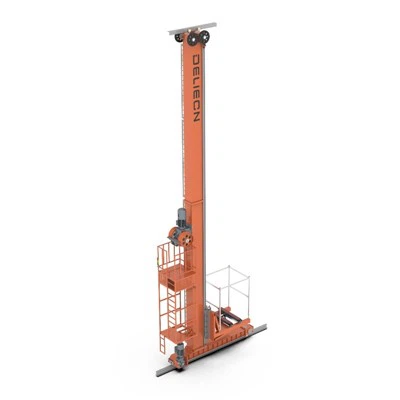
The resulting program combines a single-rail dual-stacker-crane pallet AS/RS with a tote AS/RS, connected through conveying, vertical transfer, and rail-guided transport.
Constraint 1: Limited Footprint, Complex Interfaces
The AS/RS had to be integrated into a restricted inter-building zone. This directly influenced:
• aisle and rail layout
• equipment installation and maintenance access
• staging buffers for inbound/outbound operations
• structural interfaces for multi-floor production supply
• To address this, DELIECN adopted a single-rail dual-crane configuration for the pallet AS/RS, aiming to balance space efficiency with operational continuity.
Constraint 2: Multi-Floor Production Supply
Supplying two-floor production lines requires more than storage density. It requires controlled handover points and vertical transfer.
In the delivered design:
• a front-area steel platform connects the AS/RS to first- and second-floor logistics nodes
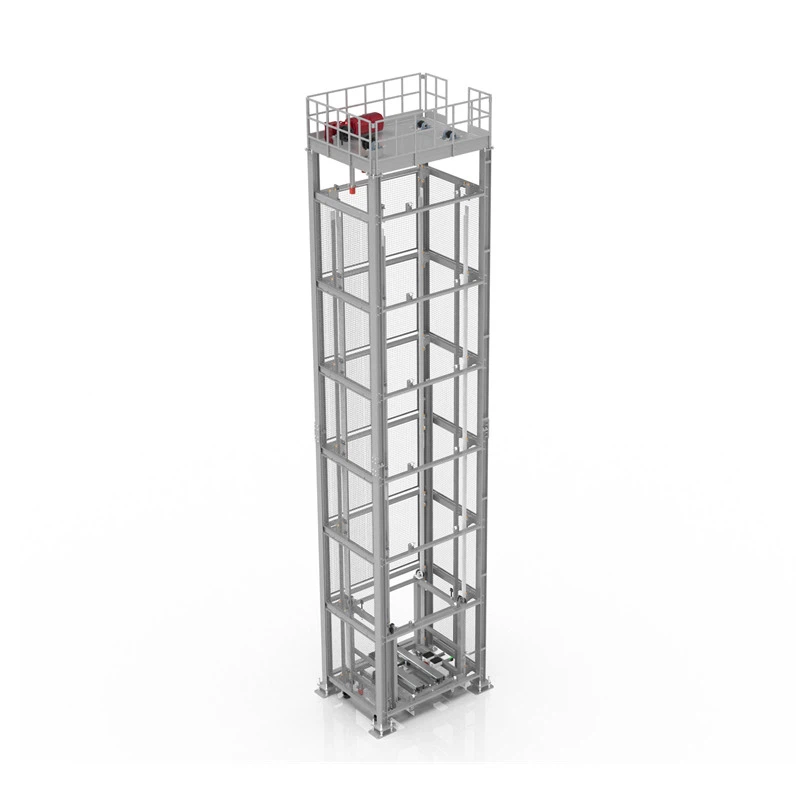
• lifters and conveying modules support cross-floor movement
• RGV-based transport helps stage pallets and reduce waiting time at handover points
Constraint 3: Mixed Loads Under Tight Takt Time
The plant needed to handle two fundamentally different material categories:
• Bulky items on pallets (stable transport and structured handling)
• Small parts in totes (high-frequency access, high SKU count, kitting demand)
• DELIECN separated these flows by using:
• Pallet AS/RS: 2,868 pallet positions; ~1,578 pallets/day reported throughput
• Tote AS/RS: 1,928 tote locations for multi-SKU inventory and frequent retrieval
• This division reduces cross-interference between heavy and small-part logistics while allowing unified process logic through warehouse software.
Material Routing Detail: Loaded vs Empty Pallet Circulation
To improve circulation efficiency and reduce footprint pressure, the pallet carrier routes were separated:
• loaded pallets routed on one level
• empty pallets returned on another level
• This supports smoother carrier turnover and reduces congestion around key transfer points.
System Software and Traceability
For manufacturing applications, physical automation must be paired with data linkage. The program includes WMS connectivity to ERP/MES, enabling:
• inventory status consistency
• process-event linkage for traceability
• centralized operational visibility via a 3D visualization control interface (project configuration)
Project-Reported Results
The customer targeted higher density and more stable line feeding:
• space utilization improved by about 3× versus conventional floor storage
• system-wide logistics efficiency improved by about 80% (reported indicator)
• goods-to-person workflows with reported accuracy up to 99.99%
• improved visibility and traceability through software integration
Engineering Lessons for Similar Plants
For factories facing corridor-style construction constraints and multi-floor supply requirements, a repeatable approach is:
1,adopt a compact crane/rail layout appropriate to aisle constraints,
2,separate pallet and tote flows to reduce interference,
3,use buffering and transport (RGV/conveyors/lifters) to protect takt time,
4,ensure WMS-to-ERP/MES linkage for traceability.