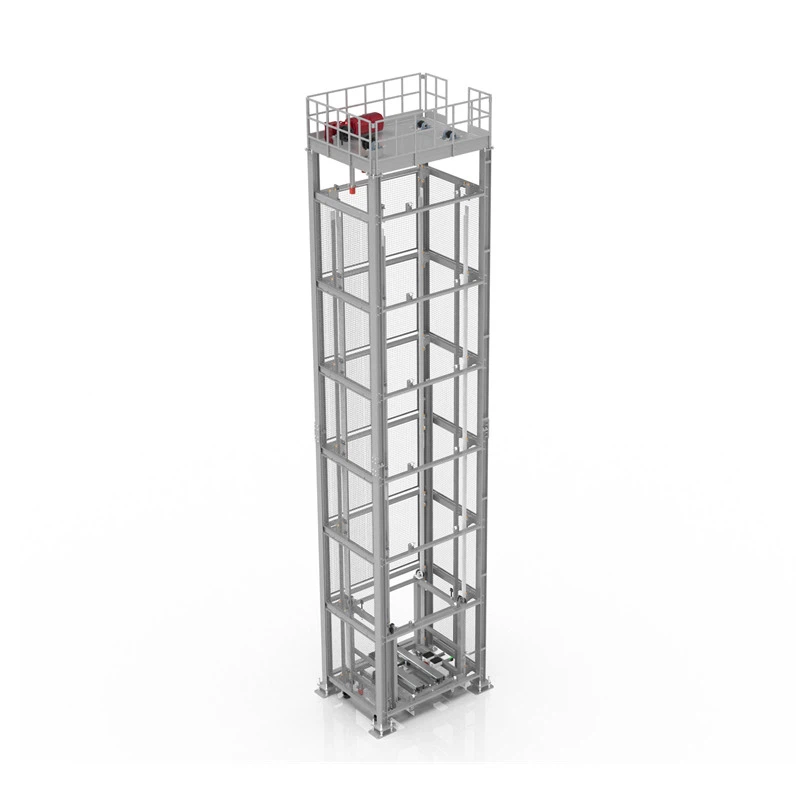
As a highly efficient logistics device, pallet stackers play a vital role in modern warehouse management. By stacking goods vertically, they significantly save warehouse space and improve storage efficiency. However, pallet stackers are not suitable for all warehouse types; they have specific application scenarios. This article will explore in detail which warehouses are best suited for using pallet stackers, hoping to provide valuable reference.
First, pallet stackers are suitable for warehouses with large volumes of goods and a single variety of goods. These warehouses typically have a relatively small number of goods, but large quantities of each item, and typically require storage and handling on standard pallets. Pallet stackers have relatively standardized operating procedures and can efficiently stack goods vertically, reducing warehouse space. However, if a warehouse has a wide variety of goods and requires the use of different types of pallets, operation becomes more complex and efficiency decreases. Therefore, pallet stackers are an ideal choice for warehouses with large volumes of goods and a single variety of goods.
Second, pallet stackers are suitable for warehouses with heavy and bulky goods. These warehouses often handle heavy cargo, such as mechanical parts and construction materials. Pallet stackers, with their robust load-carrying capacity, can stack heavy goods vertically, saving space and improving handling efficiency. Furthermore, they automate cargo handling, reducing the workload and risks of manual labor. Therefore, pallet stackers are essential logistics equipment for warehouses with heavy and bulky cargo.
Furthermore, pallet stackers are ideal for warehouses with high cargo turnover. In warehouses with frequent cargo turnover, pallet stackers can quickly stack goods to designated locations and quickly retrieve them when needed, thereby improving overall warehouse operational efficiency. Furthermore, pallet stackers enable precise positioning and management of cargo, reducing the time required to locate and move goods, further enhancing warehouse turnover efficiency. Therefore, the use of pallet stackers undoubtedly brings significant benefits to warehouses with high cargo turnover.
In addition to the three advantages mentioned above, pallet stackers are also particularly widely used in automated high-bay warehouses. An automated high-bay warehouse (AHW) is a highly integrated logistics system that uses advanced automation equipment and technologies to automate the storage, handling, and management of goods. Pallet stackers, as a key component of an AHW, work in conjunction with other logistics equipment such as shuttles and elevators to facilitate the storage and retrieval of goods. Within an AHW, pallet stackers can quickly and accurately stack and retrieve goods vertically, significantly improving warehouse storage efficiency and operational performance.
For example, a well-known e-commerce company's AHW utilizes 15 20-meter-tall stackers for high-density pallet storage. The stackers operate in a dual-cycle system, systematically storing, shelving, and picking goods. With tens of thousands of pallet slots, the system boasts a storage efficiency of 18.6 pieces per square meter. Furthermore, the company's AHW is equipped with shuttles and other equipment. The addition of 5G chips enables real-time feedback and analysis of data such as equipment status and faults. This automated solution not only improves warehouse warehousing and outbound delivery efficiency, but also reduces storage space and labor requirements, ushering in new heights in intelligent and flexible manufacturing.
However, it's important to note that pallet stackers aren't suitable for all warehouse types. For warehouses handling lightweight, small, and diverse cargo, using a pallet stacker may be too cumbersome and complex. These warehouses are better suited to other types of logistics equipment, such as automated sorting systems and lightweight racking. Furthermore, for warehouses with low cargo turnover, using a pallet stacker may be a waste of resources. The advantage of a pallet stacker lies in its fast and efficient storage and retrieval operations, which are not fully utilized in low-frequ