

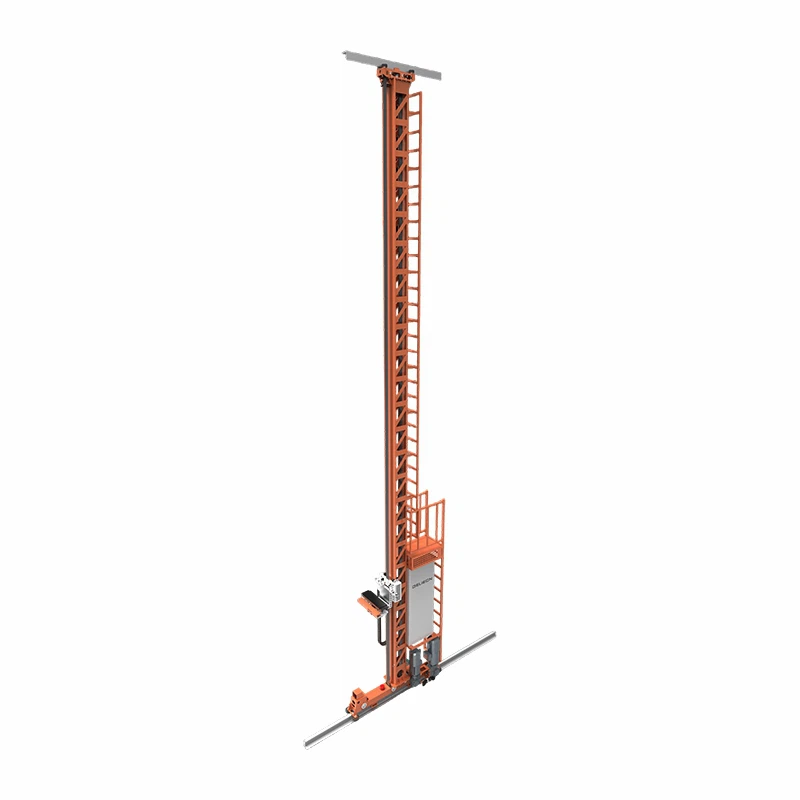
A Single-Deep Miniload Stacker Crane is mainly used for automated storage and retrieval of totes, cartons, trays, and small parts containers. Compared with double-deep systems, single-deep storage provides direct access to each location, making it suitable for warehouses with high SKU variety, frequent picking, and fast response requirements.Different load weights can affect crane speed, lifting stability, positioning accuracy, and system safety. To handle this, a Single-Deep Miniload Stacker Crane relies on mechanical strength, intelligent control, load detection, and suitable handling devices.
1. Rated Load Capacity Comes First
Each miniload stacker crane is designed with a specific rated load capacity. During system design, the total load weight must include not only the goods, but also the tote, carton, tray, or container itself.The supplier should also evaluate load size, center of gravity, bottom structure, and weight distribution. If the actual load exceeds the design range, it may affect lifting stability, positioning accuracy, and equipment life.
2. Intelligent Motion Control
For lighter loads, the crane can run at higher speed and acceleration to improve throughput. For heavier loads, the control system adjusts travel speed, lifting speed, acceleration, and braking distance to ensure smooth and safe operation.This helps reduce vibration, protect the load, and maintain accurate positioning during storage and retrieval.
3. Load Detection and Safety Protection
Modern miniload stacker cranes can be equipped with sensors and control systems to detect abnormal load conditions. When overweight, misaligned, or unstable loads are detected, the system can stop the task, send an alarm, or prevent the crane from continuing operation.Overload protection, emergency stop functions, and safety interlocks are essential for stable long-term operation.
4. Proper Load-Handling Devices
The load-handling device must match the goods. Common options include telescopic forks, belt extractors, chain extractors, and customized grippers.Standard totes and cartons usually use forks or belt-type extractors. For special containers or irregular loads, customized handling devices may be required to ensure stable picking and placing.
5. System Design Affects Real Performance
Load weight is only one factor. The actual efficiency of a Single-Deep Miniload Stacker Crane also depends on rack height, aisle length, inbound and outbound station design, WMS/WCS scheduling, and order structure.A professional supplier should evaluate the full warehouse process instead of only selecting a crane model.
Conclusion
A Single-Deep Miniload Stacker Crane handles different load weights through rated load design, intelligent speed control, load detection, safety protection, and matched handling devices.For warehouses with many SKUs, frequent picking tasks, and limited storage space, a well-designed Single-Deep Miniload AS/RS can improve storage density, picking efficiency, and inventory accuracy while ensuring safe and stable operation.
FAQ
What types of goods can a Single-Deep Miniload Stacker Crane handle?
It is mainly used for totes, cartons, trays, bins, and small parts containers. It is suitable for small to medium-sized goods rather than standard heavy pallet loads.
Is single-deep storage faster than double-deep storage?
Single-deep storage provides direct access to each location, which can improve retrieval speed and simplify inventory management. Double-deep storage offers higher density but may require additional handling logic.
What should be confirmed before choosing a miniload stacker crane?
The most important factors include load size, load weight, container type, warehouse height, storage capacity, throughput requirements, SKU quantity, picking process, and software integration needs.
Why is load weight important in miniload system design?
Load weight affects lifting speed, travel speed, acceleration, braking, positioning accuracy, safety protection, and equipment lifespan. Accurate load data is essential for reliable system design.


