

Ask what makes a tote shuttle good and most answers start with speed. That's the wrong place to begin. The useful questions are what the load looks like, how high the building goes, and how many picks the operation actually needs per hour. Two projects show how differently that same class of machine gets specified. One is a traditional medicine warehouse in Changchun. The other is an electrical connector plant in Sichuan.
Start with the tote, not the shuttle
A tote shuttle isn't a scaled-down pallet shuttle. The loads are lighter, the mumbers are far more numerous, and picking is counted in hundreds of totes an hour rather than tens of pallets.
Look at the numbers from Jilin Beiya's medicine warehouse. A tote there measures 600 × 400 × 400 mm and carries no more than 30 kg including the box. A pallet position in the same building takes a 1,000 × 1,000 mm base and up to 400 kg. Two loads like that need different machines, different lifters and different rack tolerances. You can't reuse a pallet shuttle design and call it a tote solution.
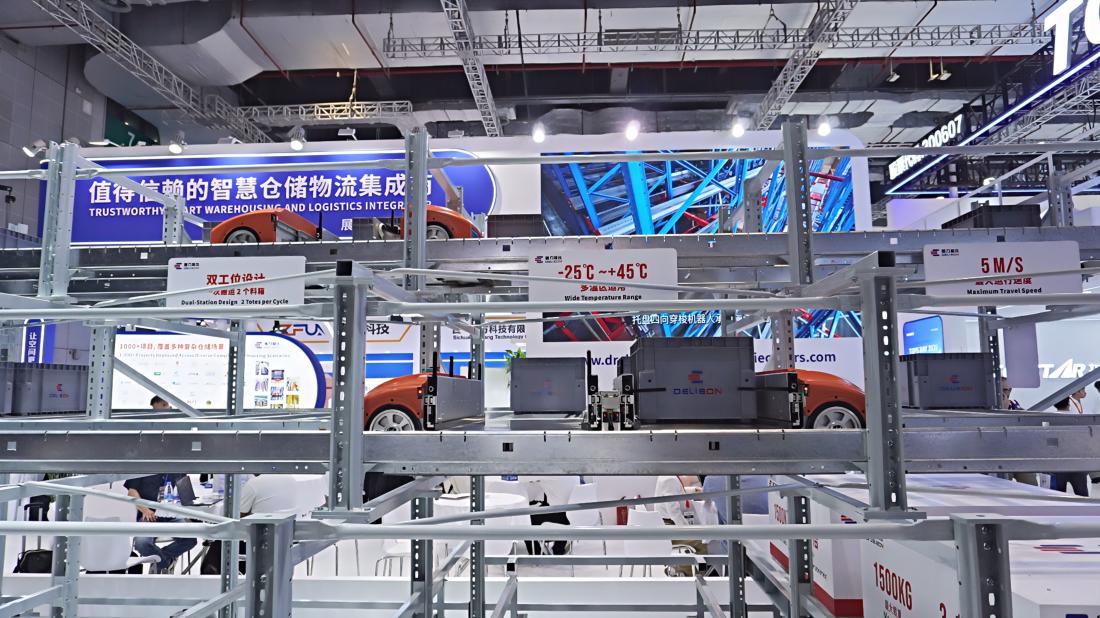
Speed follows from the same distinction. In DELIECN's specification set, a tote shuttle runs at about 5 m/s against roughly 2 m/s for a pallet shuttle. That extra speed only pays off when the picking face can keep up. That's why the tote machine is normally paired with lifters, conveyors and a goods-to-person station instead of a forklift.
The features that matter above twelve metres
Once storage climbs past roughly twelve metres, the shuttle's job changes. It's no longer just moving totes down a row. It's trading horizontal travel for vertical density and depending on lifters to get each tote back to the operator.
Four capabilities do most of the work:
- Layer changing. A layer-changing lifter moves the shuttle between levels, while high-speed lifters hand totes down to the picking station. Beiya runs one layer-changing lifter and four high-speed lifters against twelve shuttles.
- Traffic control. The WCS assigns tasks and manages routes so a dozen machines in one block don't queue at the same crossing. Beiya's system uses resource management, route management and route traffic-control algorithms.
- Cross-floor flow. At Yonggui, storage circulation and production picking follow the manufacturing rhythm across floors one to four, not a single warehouse level.
- Goods-to-person picking. The shuttle delivers the tote to a circulating conveyor and the operator stays put. This is the feature that turns raw density into labour savings.
Jilin Beiyao: 22,000 positions on twelve machines
Jilin Beiyao is the largest private producer of Chinese medicine decoction pieces in north-east China, turning out more than 2,000 product specifications and around 35,000 tonnes a year. Its new warehouse had to hold all of that under GSP and GMP rules, and pick it accurately.
The tote side of the project is a four-way shuttle AS/RS laid out as 25 groups × 8 per group × 5 rows × 22 levels - 22,000 effective tote positions. Twelve tote four-way shuttles work the racking, supported by one layer-changing lifter and four high-speed lifters. Alongside it sits a separate pallet stacker crane system with 2,400 positions.
Space utilisation reaches 95%. Inbound and outbound handling runs at 450 totes per hour, about 80% faster than the old flat warehouse, with data accuracy quoted at 99.99%. The installation team took just three months to move from site entry to a ready-for-acceptance state.
What matters for this article is the ratio: twelve machines cover 22,000 positions. The density comes from the racking and the lifters, not from buying more shuttles.
Yonggui: fifty-one levels for 9,700 component types
Sichuan Yonggui makes electrical connectors and electromechanical products for the automotive industry. Its warehouse reached about 22.3 metres - a very different planning condition from a flat store - so maximising vertical space became the priority.
The result is a 51-level tote four-way shuttle warehouse holding more than 9,700 types of automotive components. Eight shuttles work collaboratively, reaching a throughput of up to 323 totes per hour. Peak inbound handling is roughly 370 SKUs a day and peak outbound around 872 SKUs a day. Storage capacity went up about ten times, warehouse turnover improved by 200%, and labour cost dropped by a factor of two.
Yonggui is a useful counterweight to Beiyao. Same class of machine, similar light loads, a completely different building - and a different set of trade-offs written into the layout.
The counterintuitive part: two-way, four-way, and why height decides
Here's the thing the product names hide. Both projects above use four-way tote shuttles, not two-way ones. A two-way tote shuttle runs back and forth along a single lane and needs a lifter to change levels or a transfer point to change aisles. A four-way machine can also turn across the head of an aisle, which buys you routing flexibility in a dense, multi-level block.
So does that make two-way the weaker option? No. It makes it the cheaper and simpler one, and in a low, straight warehouse with stable SKUs it can be the better buy. The mistake is choosing the configuration before you've measured the building.
The deciding variable is height. Above about twelve metres, the value of each shuttle rises because it can reach levels a person never would, and the cost of a wrong routing decision rises with it. That's where four-way machines and serious traffic-control software earn their keep. Below that line, the maths changes and a different machine often wins.
The dual-station tote shuttle
One of the more interesting recent changes is the dual-station tote four-way shuttle. It carries two totes in one cycle instead of one, and it supports eight operating modes covering storage, retrieval and preparation work during idle time.
The benefit shows up most clearly at second-depth positions, where a single-station machine would otherwise make an extra trip to clear the front slot. Carrying two totes shortens that handling time and gives the scheduler more ways to organise work inside the rack.
It's a small mechanical change with a real scheduling payoff. It also tells you something about how this category is evolving. Progress here isn't measured only in faster motors. A machine that does more before returning to the lifter is worth just as much.
Below twelve metres: where Mini-FlyBox fits
For facilities that don't need a high-bay, DELIECN's Mini-FlyBox is usually the better recommendation. It serves multi-SKU small-item storage and goods-to-person picking, with operating aisles as narrow as 860 mm. Toyota's installation holds more than 17,000 tote positions - over 10,000 in an H300 zone across 15 levels and another 7,000 in an H450 zone across 11 levels.
Mini-FlyBox connects to tote AMRs, conveyors and picking workstations, so the route from storage to operator can be fitted around the building rather than the other way round. The published comparison puts it plainly. Mini-FlyBox suits many SKUs, frequent picking and limited space. A tote shuttle suits large storage capacity, a high warehouse and dense storage.
There is no universally perfect machine here. The right answer depends on warehouse height, SKU count, picking frequency, material flow and the rhythm of production.
When a tote shuttle is the wrong call
Skip it if your loads are heavier than the machine is built for. The Beiyao totes top out at 30 kg including the box. A heavier load belongs on a pallet shuttle or a stacker crane.
Skip it if the building is low and your SKU count is modest. The economics of a multi-level shuttle depend on having enough levels to make the lifters and the control software worthwhile. A flat store with a few hundred positions doesn't give you that.
Skip it if you can't connect the shuttle to a WCS/WMS. Without task assignment and route control, a fleet of machines in one block turns into a traffic problem rather than a throughput gain.
And be careful with the phrase "two-way shuttle" in a specification. Decide first whether you need lane-only movement or cross-aisle turning, then match the configuration to the building. Buying the name and hoping for the flexibility rarely works.
What to check before you choose
Start with the tote dimensions and weight, then the clear height, then the number of SKUs and the picks per hour. Ask how many machines the layout actually needs and what the lifters are doing while they work. Then ask what happens at twelve metres, because that's usually where the answer flips from Mini-FlyBox to a tote shuttle.
FAQ
How fast is a tote shuttle compared with a pallet shuttle? Roughly 5 m/s versus 2 m/s in DELIECN's specification set. The higher speed only helps when lifters, conveyors and picking stations can absorb it.
How many totes can one project handle? Jilin Beiyao runs 450 totes per hour across twelve machines; Yonggui reaches up to 323 totes per hour with eight. Both figures are tied to those specific layouts.
Why choose a tote shuttle over Mini-FlyBox? When storage capacity and building height dominate. Mini-FlyBox suits many SKUs with frequent picking in limited space; tote shuttles suit high, dense stores.
What does a dual-station tote shuttle change? It carries two totes per cycle and supports eight operating modes, cutting extra trips to second-depth positions and giving the scheduler more options.


