

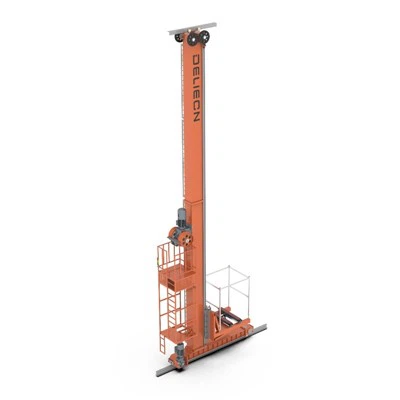
In automated storage and retrieval systems, a Single-Mast Pallet Stacker Crane is widely used for pallet storage and retrieval in high-bay warehouses. It travels along a fixed aisle, lifts pallets vertically, and uses a fork mechanism to place or retrieve goods from racking positions.
Compared with double-mast stacker cranes, a single-mast design has a more compact structure and is suitable for pallet AS/RS projects with specific load, height, aisle width, and throughput requirements. Its stability does not depend on simple "balance" like a forklift. Instead, it is ensured through structural design, rail guidance, load control, drive control, installation accuracy, and safety protection.
Stability Starts from Structural Design
The mast is the main load-bearing structure of a Single-Mast Pallet Stacker Crane. During operation, it must withstand vertical loads, horizontal movement forces, acceleration and deceleration forces, lifting forces, and fork extension forces.
A professionally designed mast uses high-strength steel structure, reasonable section design, and sufficient rigidity to reduce bending, vibration, and sway during high-speed travel and lifting. The structural strength and stiffness of the mast directly affect the crane's positioning accuracy, operating stability, and long-term reliability.
For higher warehouses or heavier pallet loads, the mast design must be carefully calculated according to load capacity, lifting height, travel speed, acceleration, and operating frequency.
Rail-Guided Operation Improves Stability
Unlike mobile handling equipment, a pallet stacker crane does not move freely on the warehouse floor. It runs along a fixed lower rail and is usually guided by an upper guide rail or top guiding system. This rail-guided structure helps the crane maintain a stable travel path and reduces lateral deviation during operation.
The lower rail supports the crane's travel movement, while the upper guide system helps control mast sway and keeps the crane aligned in the aisle. This upper and lower guidance structure is one of the key reasons why stacker cranes can operate stably at high speed and high lifting height.
Therefore, the installation accuracy of the rail system is very important. Rail straightness, levelness, parallelism, foundation quality, and anchoring reliability all affect the long-term stability of the stacker crane.
Load Capacity and Center Control
Although a stacker crane is rail-guided, load control is still critical. Each crane is designed with a rated load capacity, and the pallet weight must remain within the allowed range.
If the pallet is overweight, unevenly loaded, damaged, or not correctly positioned on the fork, it may affect lifting stability, fork operation, and transfer accuracy. In serious cases, it may cause abnormal vibration, load shifting, or equipment alarm.
To improve operational stability, the system can use load detection, pallet position detection, fork status detection, and equipment interlock. The crane should only lift, travel, or extend the fork when the pallet is correctly positioned and the system confirms that the operation is safe.
Speed, Acceleration, and Anti-Sway Control
The stability of a Single-Mast Pallet Stacker Crane is closely related to its motion control. High-speed travel and lifting can improve warehouse throughput, but uncontrolled acceleration, sudden braking, or improper speed curves may increase vibration and mast sway.
A professional control system uses optimized acceleration and deceleration curves to make the crane start, stop, lift, and lower smoothly. This helps reduce mechanical impact, protect the load, and improve positioning accuracy.
For high-bay or high-speed applications, anti-sway control and precise drive control are especially important. They help the crane maintain stable movement when carrying pallets at different heights.
Fork Mechanism Stability
The fork mechanism is responsible for placing and retrieving pallets from racking locations. During fork extension and retraction, the system must ensure that the crane is accurately positioned and that the pallet is stable.
Fork position detection, extension limit protection, retraction confirmation, and load presence detection are commonly used to prevent abnormal operation. The crane should not travel or lift at high speed unless the fork has fully returned to its safe position.
This prevents mechanical interference between the fork, pallet, racking, and conveyor interface, improving both safety and stability.
Lifting System and Anti-Fall Protection
The lifting system is another core factor affecting stacker crane stability. A Single-Mast Pallet Stacker Crane uses a lifting mechanism to move the carriage and pallet vertically along the mast.
To ensure safe lifting, the system should include lifting limit protection, braking protection, overload protection, slack rope or chain detection, and anti-fall protection according to the project design. These devices help prevent abnormal lifting movement, uncontrolled descent, and load instability.
Reliable lifting control also helps the crane stop accurately at each storage level and complete pallet transfer smoothly.
Installation Accuracy and Rack Interface
The stability of a stacker crane is not only determined by the crane itself. It is also related to the whole AS/RS installation environment.
The racking system, rail foundation, aisle alignment, conveyor interface, and docking points must be installed accurately. If the rail is uneven, the rack position is misaligned, or the conveyor interface is not properly calibrated, the crane may experience vibration, positioning deviation, or transfer errors.
Therefore, professional installation, commissioning, and system calibration are essential for stable long-term operation.
Electrical Interlock and Safety Protection
Modern Single-Mast Pallet Stacker Cranes are equipped with multiple electrical and mechanical safety protections. These may include emergency stop devices, travel limit switches, lifting limit switches, fork position sensors, overload protection, speed monitoring, braking systems, safety PLC, access door interlocks, and warning lights.
These safety devices help the system detect abnormal conditions and stop operation before a fault develops into a serious risk.
For example, if the crane detects overtravel, overload, abnormal fork position, blocked transfer, communication interruption, or equipment conflict, the control system can trigger an alarm or protective stop.
WCS Scheduling and Equipment Coordination
In a complete AS/RS project, the stacker crane does not operate alone. It works together with conveyors, RGVs, AGVs, palletizers, lifters, WMS, and WCS.
The WCS coordinates task execution, equipment status, storage location allocation, and transfer interface conditions. Before the crane executes a pallet transfer, the system checks whether the target position is available, whether the conveyor is ready, and whether the related equipment has completed its previous action.
This system-level interlock helps reduce equipment conflict, incorrect transfer, and unnecessary downtime, making the whole automated warehouse more stable and reliable.
Preventive Maintenance for Long-Term Stability
Even with a strong structure and advanced control system, regular maintenance is still necessary. Key components such as rails, guide wheels, drive units, brakes, lifting mechanisms, forks, sensors, cables, and safety devices should be inspected according to a maintenance schedule.
Preventive maintenance helps identify rail wear, loose fasteners, abnormal vibration, sensor deviation, brake wear, and other potential issues before they affect system stability.
For high-frequency automated warehouses, stable operation depends not only on equipment quality, but also on proper maintenance and timely technical support.
Comparison with Double-Mast Pallet Stacker Cranes
Compared with double-mast pallet stacker cranes, single-mast stacker cranes are more compact and can be suitable for projects with moderate load requirements, limited aisle space, or specific layout needs.
Double-mast stacker cranes generally provide higher structural rigidity and are often used for heavier loads, higher lifting heights, or more demanding operating conditions. However, this does not mean a single-mast stacker crane is unstable. When properly designed, installed, and controlled, a single-mast structure can deliver stable and reliable performance for suitable pallet AS/RS applications.
The key is to match the crane type with pallet weight, warehouse height, aisle design, throughput demand, and operating environment.
Conclusion
The stability of a Single-Mast Pallet Stacker Crane is achieved through a complete engineering system. Mast rigidity, rail-guided travel, load control, optimized speed curves, fork position detection, lifting safety protection, installation accuracy, WCS coordination, and preventive maintenance all work together to ensure safe and stable operation.
For customers, choosing a stacker crane is not only about selecting single-mast or double-mast equipment. It is about selecting the right AS/RS solution based on warehouse height, pallet load, storage density, operating frequency, safety requirements, and long-term maintenance needs.
With professional design, reliable manufacturing, accurate installation, and integrated WMS/WCS control, a Single-Mast Pallet Stacker Crane can support stable, efficient, and safe pallet handling in modern automated warehouses.
If your warehouse needs to improve storage density, pallet handling efficiency, and automated storage stability, DELIECN can provide customized stacker crane AS/RS solutions, including stacker cranes, racking systems, conveyors, WMS/WCS software, safety protection devices, and full project integration support.


