

As warehouses handle more SKUs, smaller order batches, faster replenishment cycles, and higher labor pressure, companies are looking for a more flexible way to automate tote storage and retrieval. Traditional MiniLoad ASRS systems and tote shuttle systems are still widely used, but not every warehouse needs a high-investment, highly complex automation solution.
For many facilities under 12 meters high, especially manufacturing warehouses, spare parts warehouses, line-side storage areas, e-commerce buffer zones, and small-item picking centers, Mini-FlyBox is becoming a smarter alternative. It offers a strong balance between storage density, operational efficiency, deployment speed, system flexibility, and investment return.
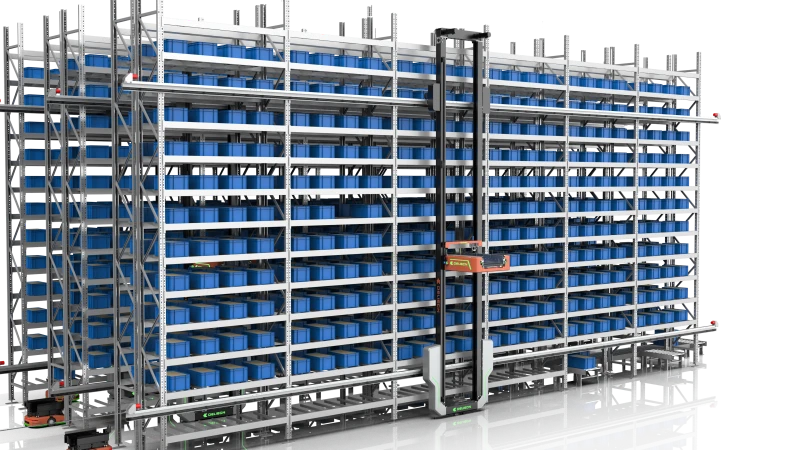
DELIECN Mini-FlyBox is designed for high-density tote storage environments. It uses horizontal tracks attached to the rack, vertical lifting modules, and a cargo platform to move along the racking system and complete tote storage and retrieval operations. The system is compatible with different tote types and supports flexible, efficient warehouse operations.
What Is Mini-FlyBox?
Mini-FlyBox is a tote-handling robot designed for automated tote storage and retrieval. Unlike a traditional MiniLoad crane that travels inside a dedicated aisle, or a tote shuttle that runs on each storage level, Mini-FlyBox operates along the racking structure through horizontal tracks and vertical lifting modules.
In simple terms, Mini-FlyBox performs three core actions:
It travels horizontally along the rack.
It lifts vertically to reach different storage levels.
It picks and places totes through its cargo platform and telescopic mechanism.
This design makes it especially suitable for medium-height tote storage systems. DELIECN Mini-FlyBox supports single-deep and double-deep storage, a maximum operating height of 12 meters, a maximum payload of 50 kg, and an operating temperature range from -25°C to +45°C. It is also designed for standard 600×400 mm totes and can be customized according to project needs.
Mini-FlyBox vs. MiniLoad: Why Mini-FlyBox Can Deliver Better Cost Performance
MiniLoad ASRS systems are suitable for high-bay, high-throughput, and highly standardized tote storage projects. They are often used in large automated warehouses where long aisles, high racking, and centralized storage are required.
However, in many real warehouse projects, the building height is below 12 meters. In these cases, a traditional MiniLoad system may bring higher equipment investment, more complex installation requirements, and a longer payback cycle. Mini-FlyBox provides a lighter and more flexible alternative.
1. Better Match for Warehouses Under 12 Meters
MiniLoad systems are often more valuable when the warehouse has enough height and scale to fully utilize their capability. For 6–12 meter warehouses, Mini-FlyBox can make better use of the available vertical space without over-investing in a larger crane-based system.
DELIECN Mini-FlyBox supports racking heights up to 12 meters, making it well-suited for medium-height warehouses, line-side warehouses, spare parts storage, and small-item automated storage areas.
2. Lower System Complexity
A MiniLoad project usually requires stacker cranes, crane rails, high-precision aisle construction, safety fencing, inbound and outbound conveyor interfaces, and a relatively fixed system layout. Mini-FlyBox uses a more modular structure, including the walking unit, lifting unit, cargo platform, and control system.
This simpler structure can reduce project complexity, making it easier to deploy in existing warehouses or facilities with space limitations.
3. Faster Deployment and Easier Expansion
One of the key advantages of Mini-FlyBox is rapid deployment. DELIECN's product design supports quick installation, flexible expansion, low construction cost, and easy maintenance through modular lifting and travel power components.
For companies that want to automate step by step instead of building a large ASRS at once, Mini-FlyBox offers a more practical path. The system can start with a smaller storage area and expand later as order volume, SKU quantity, or production demand increases.
4. Faster Return on Investment
Because Mini-FlyBox can reduce upfront system complexity and construction pressure, it can help companies shorten the payback period in suitable scenarios. For warehouses below 12 meters, where the full capability of a MiniLoad crane may not be necessary, Mini-FlyBox can provide a stronger cost-performance ratio.
This does not mean Mini-FlyBox replaces MiniLoad in every case. For very high warehouses or extremely high-throughput projects, MiniLoad may still be the better choice. But for medium-height tote automation projects, Mini-FlyBox is often a more economical and flexible option.
Mini-FlyBox vs. Tote Shuttle Systems: Why It Is More Flexible Under 12 Meters
Tote shuttle systems are widely used in high-throughput goods-to-person picking scenarios. They are suitable for large e-commerce, retail, pharmaceutical, and high-frequency order fulfillment operations.
However, tote shuttle systems usually require multi-level tracks, multiple shuttle robots, lifting equipment, charging or power management, complex traffic control, and a more complete system layout. For warehouses under 12 meters, especially those with moderate throughput requirements, this may create unnecessary investment and system complexity.
Mini-FlyBox offers a more compact and flexible choice.
1. Simpler Structure for Medium-Throughput Applications
Tote shuttle systems are strong in high-concurrency operations, but they can be over-configured for medium-scale storage and picking tasks. Mini-FlyBox combines horizontal travel, vertical lifting, and tote handling in one system structure, making it easier to apply in warehouses that need automation but do not require extremely high robot density.
2. More Flexible Ground-Level Layout
DELIECN Mini-FlyBox can be integrated with Tote AMRs. Since Mini-FlyBox operates along the rack and does not interfere with ground-level travel, AMRs can move freely underneath or around the storage area. This enables a flexible tote-to-person solution that combines high-density storage with mobile robot delivery.
This is especially valuable for warehouses that need to connect storage areas with picking stations, production lines, packing zones, or temporary buffer areas.
3. Flexible Workstation Design
Mini-FlyBox can also connect with conveyor lines to support higher inbound and outbound throughput. DELIECN's product material highlights that the system can integrate with conveyor systems and customized rack designs for different conveyor installations.
This means the warehouse layout does not need to be limited to one fixed picking mode. Companies can choose AMR-based delivery, conveyor-based flow, or a mixed solution according to their process.
4. Faster Implementation in Existing Warehouses
For existing warehouses, installing a full tote shuttle system may require major changes to the rack structure, floor layout, traffic routes, and system interfaces. Mini-FlyBox has lower requirements on floor conditions because of its suspended track design. This makes it more suitable for renovation projects and facilities where civil construction changes must be minimized.

Core Advantages of DELIECN Mini-FlyBox
High Storage Density
Mini-FlyBox supports high-density tote storage by using vertical space efficiently. The system supports racking heights up to 12 meters. Its aisle width can be narrowed to 860 mm for single-deep storage and 1100 mm for double-deep storage, helping warehouses increase storage capacity within limited floor space.
High Operating Efficiency
DELIECN Mini-FlyBox uses track travel and a servo motor control system to improve horizontal and vertical movement speed. According to the product specifications, it supports a maximum walking speed of 3 m/s, maximum walking acceleration of 2 m/s², maximum lifting speed of 3 m/s, and telescopic fork speed of 1 m/s.
This allows the system to respond quickly to storage and retrieval tasks, especially in multi-SKU and high-frequency picking environments.
Continuous Operation Without Charging Downtime
Mini-FlyBox is powered by conductor rail, which eliminates charging downtime and supports continuous operation. This is important for warehouses running multiple shifts, production-line replenishment, or order fulfillment tasks with limited buffer time.
Strong Floor Adaptability
The suspended track design reduces dependence on floor conditions. Compared with some ground-rail or high-precision floor-based automation systems, Mini-FlyBox is easier to apply in warehouse renovation projects, older facilities, and space-limited areas.
High Compatibility
Mini-FlyBox supports different tote sizes and multi-level rack designs with customized layer heights. This makes it suitable for warehouses with diverse SKUs, multiple packaging sizes, and changing storage requirements.
Flexible Integration with AMR and Conveyor Systems
Mini-FlyBox can work with Tote AMRs to build a flexible tote-to-person solution, or connect with conveyor lines to support higher-throughput storage and retrieval. This makes it more than a single storage device; it becomes part of an integrated warehouse automation solution.
Safe and Reliable Operation
DELIECN Mini-FlyBox is designed with obstacle avoidance lasers, photoelectric detection, anti-drop lifting mechanisms, and anti-twist travel designs. These safety features help protect equipment, goods, and warehouse operations during storage and retrieval.
Application Scenarios of Mini-FlyBox
1. Manufacturing Line-Side Storage
Manufacturing companies often need fast access to small parts, tools, semi-finished products, and production materials. Mini-FlyBox can be used as a line-side automated storage system, connecting storage with AMRs, conveyors, or manual workstations.
2. Spare Parts Warehouses
Automotive parts, machinery parts, electronics components, and maintenance materials usually involve many SKUs and small picking quantities. Mini-FlyBox helps improve location management, reduce manual searching, and support faster picking.
3. E-Commerce and Retail Buffer Warehouses
For e-commerce and retail operations, Mini-FlyBox can support high-density tote storage and flexible order picking. It is suitable for medium-throughput areas, pre-picking zones, return handling zones, and replenishment buffer areas.
4. Pharmaceutical and Medical Supply Warehouses
Pharmaceutical and medical warehouses often require batch management, traceability, and accurate picking. Mini-FlyBox can work with WMS and WCS systems to support automated storage, retrieval, and order preparation.
5. Cold Chain and Low-Temperature Storage
With an operating temperature range from -25°C to +45°C, Mini-FlyBox can be used in selected low-temperature and normal-temperature storage environments.
6. Existing Warehouse Automation Upgrades
For warehouses that want to improve automation without large-scale reconstruction, Mini-FlyBox provides a practical solution. Its modular design, quick deployment, and lower floor requirements make it suitable for phased automation upgrades.
Future Development Trends of Mini-FlyBox
Trend 1: From Storage Automation to Flexible Tote-to-Person Solutions
Future warehouse automation will not only focus on storage density. It will also focus on how quickly goods can move from storage to picking, packing, production, or shipping. Mini-FlyBox can be combined with AMRs, conveyors, and workstations to create a more flexible tote-to-person system.
Trend 2: More Demand from Medium-Height Warehouses
Many warehouses are not 20 or 30 meters high. A large number of manufacturing and distribution facilities operate within the 6–12 meter height range. This creates strong demand for automation systems that are lighter, faster to deploy, and more cost-effective than traditional high-bay ASRS solutions.
Trend 3: Modular and Phased Automation
Companies are becoming more cautious about automation investment. Instead of building a large system at once, many prefer modular solutions that can be expanded step by step. Mini-FlyBox fits this trend because it supports flexible expansion and lower initial construction pressure.
Trend 4: Deeper Integration with WMS and WCS
The future value of Mini-FlyBox will depend not only on hardware performance, but also on software intelligence. By integrating with WMS, WCS, ERP, MES, and order management systems, Mini-FlyBox can support smarter inventory allocation, task scheduling, picking sequence optimization, and real-time warehouse visibility.
Trend 5: Wider Use in Production Logistics
More factories are moving from traditional storage to automated production logistics. Mini-FlyBox can serve as a bridge between warehouse storage and production line delivery, helping manufacturers improve replenishment speed, reduce manual handling, and stabilize production flow.
Conclusion: Mini-FlyBox Is a Smart Choice for Tote Automation Under 12 Meters
Mini-FlyBox is not simply a replacement for MiniLoad or tote shuttle systems. Its real value is in providing a more cost-effective, flexible, and fast-deploying tote storage and retrieval solution for warehouses under 12 meters.
Compared with MiniLoad, Mini-FlyBox can offer better cost performance and faster ROI in medium-height tote storage projects. Compared with tote shuttle systems, it can be more flexible and easier to deploy in scenarios where extremely high robot density is not required.
With high-density storage, 12-meter operating height, 50 kg payload capacity, continuous conductor rail power supply, modular design, AMR and conveyor integration, and reliable safety protection, DELIECN Mini-FlyBox provides a practical path for companies upgrading from manual tote storage to intelligent warehouse automation.
For manufacturers, spare parts warehouses, e-commerce operations, pharmaceutical warehouses, and existing facilities looking for a faster and more flexible automation upgrade, Mini-FlyBox is a new-generation tote storage and retrieval solution worth serious consideration.


