Safety in an automated pallet warehouse depends on more than a robot's ability to move a heavy load. A shuttle must reach the correct storage position, detect obstacles, respond to abnormal conditions and coordinate with other equipment without creating unnecessary risks.These requirements become more demanding as storage density increases and multiple robots operate simultaneously. A positioning error, an unexpected obstacle or a poorly coordinated movement can affect not only one pallet but also the surrounding operation.DELIECN addresses these risks through several layers of protection, combining positioning technology, onboard safety devices, PLC control and intelligent software scheduling.
Precise Positioning Helps Prevent Handling Errors
A pallet shuttle must stop at the correct position before transferring a load. If its position deviates from the intended location, pallet transfer may become unreliable and increase the risk of interference with the racking or adjacent equipment.
DELIECN Pallet Four-Way Shuttle Robots use a combination of encoders, laser ranging and barcode positioning to achieve positioning accuracy of approximately ±2 mm.
These technologies provide complementary positioning references, helping the robot determine its location and reach the assigned position accurately. This is particularly important in high-density racking, where clearances are limited and pallets must be transferred consistently.Accurate positioning supports safer, more repeatable handling. However, it must work alongside correctly designed racks, suitable pallets and properly configured transfer positions. Positioning accuracy alone cannot compensate for damaged pallets or unsuitable storage conditions.

Obstacle Detection Stops Movement When Necessary
Automated warehouses do not always operate under ideal conditions. An unexpected object may enter a robot's travel path, or an abnormal situation may arise during equipment operation.
DELIECN shuttle robots are equipped with obstacle detection devices around the vehicle body. When an obstacle is detected, the robot can automatically stop, helping prevent collisions and allowing the situation to be assessed before movement resumes.
This protection is especially relevant when multiple automated devices share operating areas or when the shuttle works near transfer interfaces.The effectiveness of obstacle detection also depends on appropriate sensor configuration, operating conditions and maintenance. Detection devices must remain functional, and the system must be configured to respond correctly to the hazards expected in the warehouse.
Siemens PLC Control Supports Reliable Equipment Operation
Safety devices need a dependable control system to turn their signals into appropriate machine responses.
DELIECN uses Siemens PLC controllers in its shuttle equipment. The PLC coordinates equipment logic and control signals, supporting consistent execution of movement commands and responses to detected conditions.
The controller works with the positioning system and onboard safety devices as part of the overall control architecture. When an abnormal signal occurs, the equipment needs to respond according to its configured logic rather than continue operating as if nothing has happened.For warehouse operators, reliable control is important because safety depends on the complete sequence of actions, not just the presence of individual sensors.

Additional Detection and Alarm Functions Improve Awareness
Not every abnormal condition can be prevented through positioning or obstacle detection alone. Operators also need to know when the equipment encounters a condition requiring attention.
DELIECN provides additional safety-related functions, including re-entry detection and intelligent voice alarms.
These functions support the identification of specific abnormal conditions and help draw attention to situations that require inspection or intervention. The exact role of each detection function depends on the equipment configuration and the intended application.
For projects with additional environmental or operational requirements, automatic cleaning and fire-extinguishing devices can also be specified as options, subject to the project design.
These options should be selected according to the warehouse's actual risks. Fire protection, for example, requires consideration of the stored materials, facility protection strategy and applicable safety requirements; an optional device should not be treated as a substitute for the complete fire protection design.
Software Scheduling Is Essential When Multiple Robots Share the Warehouse
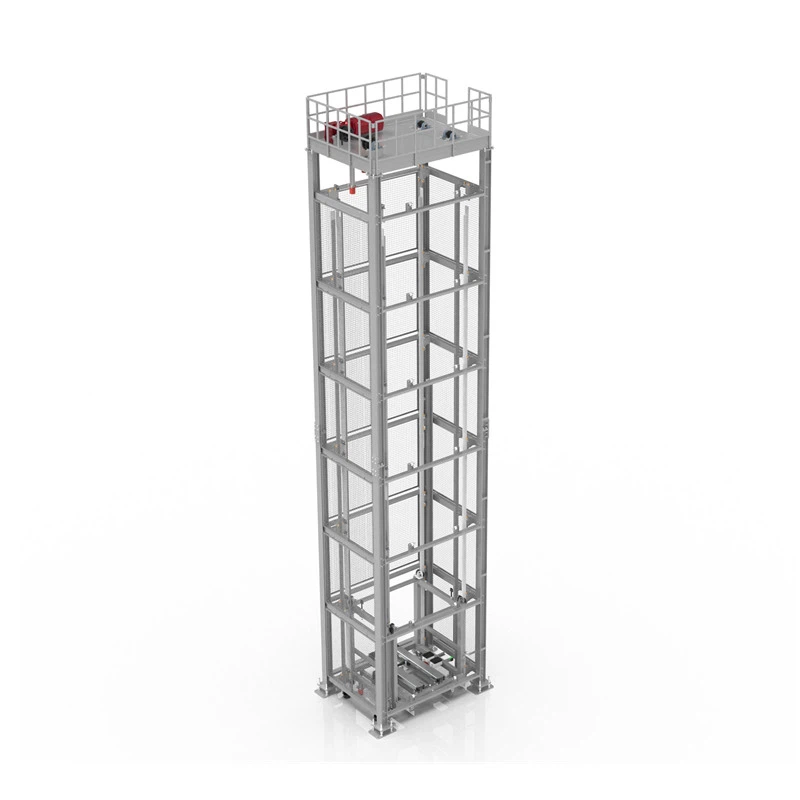
A shuttle can operate safely on its own and still encounter problems when several robots need to use the same area.Consider a warehouse in which multiple shuttles are approaching a transfer point while a Lifter is occupied. Without appropriate coordination, vehicles may wait unnecessarily, routes may become congested and task execution may be disrupted.DELIECN's software scheduling capabilities address this system-level challenge through several functions:
- Multi-system and multi-device management to coordinate equipment and connected systems.
- Equipment coordination and configurable scheduling strategies to organize task execution according to warehouse requirements.
- Equipment resource load balancing to distribute work more effectively.
- Optimal path planning and automatic avoidance control to manage movement and reduce conflicts.
- Multi-device scheduling within the same area and coordinated path control to organize robot movements where operating routes or resources are shared.
These functions help the warehouse manage interactions between devices rather than treating every shuttle as an independent machine.The distinction matters as fleets grow. Adding robots increases potential handling capacity, but it also increases the number of movements that must be coordinated. Effective scheduling helps maintain orderly traffic while supporting the required throughput.
Safe Operation Requires More Than Equipment Features
Even a well-equipped shuttle system needs appropriate operating procedures.Pallet dimensions and load stability must meet the project's handling requirements. Racking and transfer equipment must be installed and maintained correctly. Sensors, alarms and control functions need periodic inspection, while operators should understand how to respond when equipment stops or reports an abnormal condition.Software scheduling also needs to reflect the actual warehouse layout and operating rules. Changes to equipment, routes or storage arrangements should be assessed before they are introduced into live operation.For buyers evaluating a Pallet Shuttle Robot, it is worth asking the supplier how these safety functions work together, how abnormal conditions are handled and what maintenance is required to keep the system operating as intended.
Conclusion
A safe Pallet Shuttle Robot system does not rely on one sensor or one controller. It combines accurate positioning, obstacle detection, reliable PLC control, additional detection and alarm functions, and coordinated software scheduling.DELIECN integrates these capabilities to support accurate pallet handling and orderly multi-robot operation, with optional configurations available for specific project requirements.
The key is to evaluate safety across the entire warehouse operation-from an individual shuttle's movement to the coordination of the complete system. That is how automated pallet storage can support both high-density warehousing and reliable day-to-day material handling.