Introduction
Smart warehouse technology is becoming an essential part of industrial automation. As manufacturers and industrial operators face increasing pressure to improve efficiency, reduce manual handling, and gain better control over inventory, warehouse systems are evolving from static storage spaces into connected, intelligent logistics hubs.
In the past, warehouse improvement often meant adding more shelving, forklifts, or labor. Today, the focus is very different. Industrial companies are investing in automated storage systems, robotic material handling, warehouse software, and digital monitoring tools that work together as a coordinated operational platform.
In 2026, smart warehouse technologies are no longer limited to large e-commerce facilities. They are being adopted across manufacturing, pharmaceuticals, electronics, automotive, chemicals, food processing, and other industrial sectors that require high accuracy, stable throughput, and stronger operational visibility.
What Makes a Warehouse "Smart"?
A smart warehouse is more than an automated warehouse. Automation focuses on reducing manual work through machines and control systems. A smart warehouse goes further by combining automation with software intelligence, real-time data, and system connectivity.
Typical smart warehouse capabilities include:
Automated storage and retrieval
Robotic transport and handling
Real-time inventory tracking
Centralized task scheduling
Equipment status monitoring
Data-driven performance analysis
Integration with ERP, MES, WMS, and WCS platforms
This combination allows industrial facilities to move from reactive warehouse management toward more predictive, transparent, and scalable operations.
Automated Storage Systems for Industrial Warehouses
ASRS systems remain one of the most important technologies in industrial warehouse automation. These systems are widely used to improve storage density, reduce manual forklift handling, and create more consistent material flow.
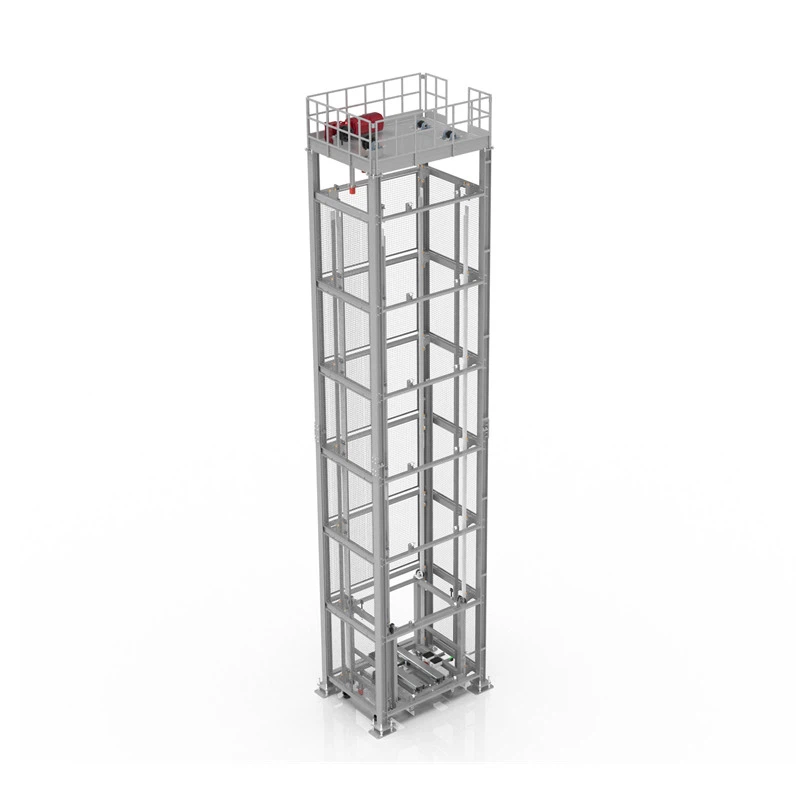
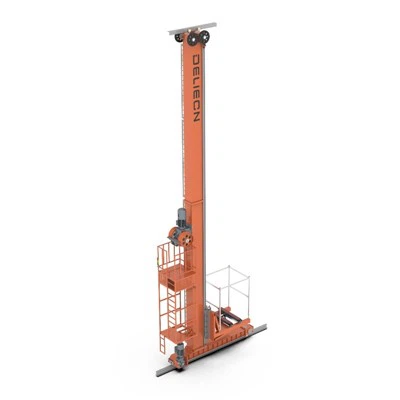
In pallet-based industrial warehouses, stacker crane AS/RS installations are commonly used for raw materials, finished goods, and production buffers. High-bay systems can support storage heights of 30 to 40 meters or more, depending on building design and application requirements.
For different operational profiles, industrial facilities may adopt:
Pallet stacker crane systems for heavy loads
Four-way pallet shuttle systems for flexible access and scalable storage
Mini-load systems for cartons, bins, and small components
Vertical storage modules for compact parts storage
These systems help industrial companies optimize cubic space, improve inventory organization, and reduce traffic congestion caused by manual handling equipment.
Robotics and Flexible Material Handling
Warehouse robotics are also playing a larger role in smart warehouse development. In many industrial environments, fixed automation alone cannot provide enough flexibility to support changing workflows or product mix.
Robotic technologies such as shuttle robots and AMRs make it possible to build more adaptive material handling systems. These robots can move pallets, totes, cartons, and containers between storage, picking, kitting, packing, and production zones.
Key advantages of robotic warehouse systems include:
Flexible routing capability
Scalable deployment based on throughput needs
Reduced dependence on labor-intensive transport
Better support for goods-to-person and line-side delivery
Easier adaptation to layout or process changes
For industrial users, this flexibility is important because warehouse and production logistics often need to respond to seasonal peaks, SKU expansion, or process reconfiguration.
Warehouse Digitalization and Operational Transparency
Warehouse digitalization is another major force behind smart warehouse development. Industrial operators need more than equipment automation. They also need clear, real-time visibility into what is happening across storage and material flow operations.
Advanced monitoring platforms can provide insight into:
Equipment utilization
Inventory movement
Task execution status
Alarm and exception conditions
Throughput and cycle time trends
Maintenance requirements
Some facilities also use 3D visualization systems or digital twins to display warehouse operations in a more intuitive way. These tools help operators identify bottlenecks faster, respond to issues more effectively, and manage increasingly complex automation systems from centralized control interfaces.
Software as the Intelligence Layer
Smart warehouse systems rely heavily on software. Hardware performs the movement, but software decides how the warehouse should operate.
A typical smart warehouse software structure may include:
WMS to manage inventory, tasks, and location rules
WCS to coordinate automation equipment in real time
ECS or control systems to execute commands at device level
ERP and MES integration to align warehouse operations with enterprise and production planning
This software architecture supports better synchronization between storage, transport, picking, and manufacturing. It also creates the foundation for more accurate data capture and performance optimization.
Why Smart Warehouse Technology Matters in Industrial Automation
Industrial automation is no longer limited to the production line. Warehousing and internal logistics now play a direct role in overall factory performance. If materials do not arrive on time, if finished goods cannot be stored efficiently, or if inventory visibility is poor, production efficiency suffers.
Smart warehouse technology helps solve these problems by improving:
Material availability
Inventory accuracy
Throughput consistency
Space utilization
Operational transparency
Coordination between logistics and manufacturing
As a result, smart warehouses are becoming a critical part of broader industrial automation strategy.
Conclusion
Smart warehouse technologies are reshaping industrial logistics in 2026. By combining ASRS systems, warehouse robotics, intelligent software, and digital monitoring tools, industrial companies can create warehouse environments that are more efficient, more transparent, and better aligned with modern production requirements.
For manufacturers and industrial operators planning future upgrades, smart warehouse development is not just a technology trend. It is a practical path toward stronger operational control, higher logistics efficiency, and more resilient industrial automation.