

Warehouse safety is one of the main reasons manufacturers introduce automated storage systems. In traditional pallet warehouses, employees may need to drive forklifts into storage aisles, handle heavy pallets, work at height, or operate in cold, dusty, and other demanding environments.
A pallet four-way shuttle robot helps reduce these risks by automating pallet movement inside the racking system. However, warehouse safety is created through the coordinated design of the shuttle robot, racking, lifters, conveyors, WMS/WCS, safety barriers, and operating procedures.
Reducing Personnel Exposure to High-Risk Areas
The most important safety advantage of a pallet four-way shuttle system is the separation of people from automated equipment.
The shuttle robot travels along rails inside the racking structure and completes pallet storage, retrieval, and internal transfer tasks automatically. Employees normally remain at designated stations rather than entering deep storage lanes.
This reduces the need for manual pallet handling inside dense racking areas and limits personnel exposure to moving equipment, heavy loads, high storage levels, and repetitive transport work.
In a properly designed system, automated operating areas should be protected by safety fencing, access doors, interlocks, warning devices, and so on.
Obstacle and Position Detection
Pallet four-way shuttle robots are equipped with sensors that monitor the operating path, pallet position, load status, and robot location.
If an unexpected obstacle, pallet misalignment, or abnormal condition is detected, the robot can slow down, stop, or send an alarm to the control system. Positioning devices also help the shuttle align accurately with storage locations and transfer points.
These functions help prevent collisions, pallet displacement, and damage to the racking system.
Sensor detection is an important safety layer, but it does not replace physical isolation. Personnel should not enter the automated racking area while the system is operating.
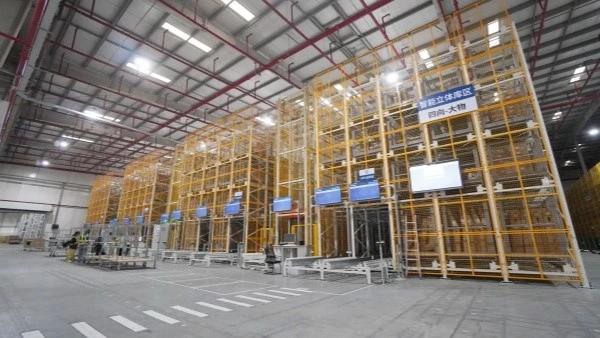
Pallet and Load Safety Checks
Many warehouse incidents are caused by damaged pallets, unstable goods, or loads that exceed the system design limits.
Before a pallet enters the automated warehouse, an inspection station can check its dimensions, weight, position, and load condition. Pallets that do not meet the permitted requirements can be rejected before they enter the racking system.
This helps prevent problems such as:
- Oversized goods colliding with the racking
- Damaged pallets becoming unstable during transport
- Loads exceeding the shuttle robot's rated capacity
- Incorrectly positioned pallets affecting transfer accuracy
For a standard DELIECN pallet four-way shuttle application, the system can be designed to handle pallet loads of up to 1,500 kg, subject to the project configuration and pallet conditions.
Safety Interlocks Between Equipment
A pallet four-way shuttle system normally operates together with lifters, conveyors, AGVs, or other material-handling equipment.
These devices must not operate independently without coordination. The WMS and WCS manage task sequences and confirm that each transfer point is ready before allowing the next movement.
For example, a shuttle robot should not deliver a pallet to a lifter until the lifter is correctly positioned and available. A conveyor should not release a pallet until the receiving station confirms that it can accept the load.
This equipment interlock logic reduces transfer conflicts and prevents pallets from entering occupied or unavailable positions.

Traffic Management for Multiple Shuttle Robots
When several shuttle robots operate in the same system, the WCS manages routes and task priorities.
The system prevents two robots from entering the same track section at the same time and coordinates access to lifters, transfer points, and cross aisles. If a route is occupied, the task can be delayed or assigned through another available path.
Effective traffic management improves both system safety and operating efficiency, especially in large warehouses with multiple robots and frequent pallet movements.
Emergency Stops and Access Control
When an emergency stop is activated, the relevant equipment is brought to a controlled stop. Safety doors and maintenance access points should also be connected to the control system. Opening a protected access door can stop the automated equipment and prevent it from restarting until the safety condition has been confirmed.
These measures ensure that maintenance personnel can enter the system only under controlled and authorized conditions.
Safety in Cold Storage and Special Environments
Pallet four-way shuttle systems may also be used in cold storage, dusty manufacturing facilities, or specially designed explosion-protected environments.
In cold storage applications, equipment must be designed with low-temperature-compatible materials, suitable batteries, sealed components, and protection against condensation. Sensors, cables, communication devices, and electrical components must remain stable under long-term low-temperature operation.
For environments with combustible dust, gas, or other explosion risks, the system requires project-specific hazard assessment and compliant explosion-protected design. A standard shuttle robot should not be used directly in such environments without proper technical evaluation and certification.
The safety solution must always be designed according to the actual temperature, humidity, dust level, fire-protection requirements, and operating conditions.
Training and Preventive Maintenance
Even a highly automated system requires proper management.
Operators should understand equipment status indicators, alarm handling, access control, emergency procedures, and the correct process for dealing with damaged pallets or abnormal loads. Maintenance personnel should receive additional training before entering automated operating areas.
Regular inspection should cover sensors, brakes, wheels, batteries, communication components, safety doors, emergency stops,and lifting equipment.
Preventive maintenance helps identify developing problems before they cause equipment failure or create safety risks.
How DELIECN Designs a Safer Shuttle Warehouse
DELIECN designs pallet four-way shuttle systems according to the customer's warehouse layout, pallet specifications, load weight, throughput requirements, operating environment, and production processes.
A complete solution may include pallet shuttle robots, high-density racking, lifters, conveyors, AGVs, pallet inspection stations, WMS, WCS, and safety fencing.
During project planning, the engineering team evaluates not only storage capacity and efficiency but also maintenance access, fire-protection requirements, abnormal-load handling, system recovery, and future expansion.
Conclusion
The safety value of a pallet four-way shuttle robot is not based on allowing robots and employees to work freely in the same area.
Its main advantage is that it reduces manual handling inside high-density racking and separates personnel from automated pallet movement. Sensors, load inspection, equipment interlocks,WMS/WCS , safety fencing, access control, and preventive maintenance work together to create a safer warehouse environment.
When evaluating a pallet four-way shuttle system, companies should consider warehouse layout, pallet condition, load weight, operating temperature, maintenance requirements, and system safety design-not only robot speed and storage capacity.
DELIECN provides customized pallet shuttle warehouse solutions covering system planning, equipment manufacturing, software integration, installation, commissioning, training, and after-sales support.
Planning a pallet shuttle warehouse project? Share your warehouse dimensions, pallet specifications, storage capacity, throughput requirements, and operating conditions with DELIECN. Our engineering team will help you evaluate a safe and practical automation solution for your facility.


