

The Challenge of Storing Large Automotive Spare Parts
Automotive spare parts warehouses rarely handle one standard pallet type. Large components, body parts, mechanical assemblies, and non-standard packaged goods may differ significantly in height, weight, dimensions, and turnover frequency.
At the spare parts warehouse of Toyota Motor , the storage center manages nearly 45,000 SKUs across multiple warehouse zones. Large spare parts are stored in cages with different height specifications, creating higher requirements for storage density, location allocation, equipment coordination, and inventory traceability.
To improve the storage and movement of large automotive parts, DELIECN deployed a pallet four-way shuttle robot AS/RS as one of the core automated storage systems in the project.
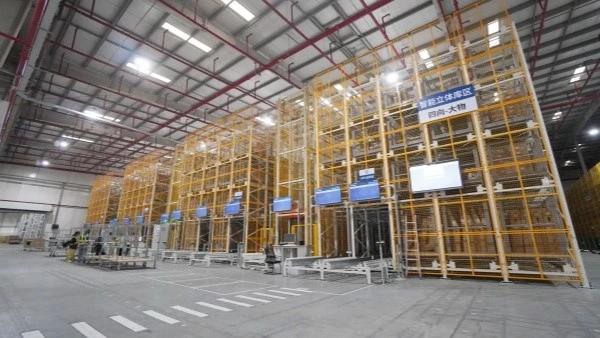
Mixed-Height Storage in One Shuttle System
The pallet shuttle warehouse uses a five-level racking structure with approximately 3,091 storage locations.
The first level is designed for storage cages up to 1,675 mm high, while levels two to five accommodate cages up to 1,200 mm high. This differentiated design allows two major load-unit specifications to be stored within the same automated system.
Instead of assigning all cargo to identical storage positions, the WMS allocates locations according to load dimensions, inventory status, task priority, and storage rules. This improves compatibility with different spare-part categories while avoiding unnecessary space above lower loads.
For automotive warehouses with several standard cage sizes, this type of mixed-height design can achieve a better balance between storage capacity and operational flexibility.
Four-Direction Movement for Flexible Storage
A pallet four-way shuttle robot can move forward, backward, left, and right along the straight rail network inside the racking system.
Unlike lane-limited storage equipment, it can travel between the main aisle and different storage lanes on the same level. This allows one robot to serve multiple lanes and gives the WCS greater flexibility when assigning tasks and routes.
The FAW Toyota project is equipped with 14 DELIECN pallet four-way shuttle robots. Under unified WCS scheduling, multiple robots can perform storage and retrieval tasks simultaneously while avoiding path conflicts and coordinating access to shared transfer points.
This multi-robot operating model helps the warehouse respond more flexibly to changes in order volume, task priority, and equipment availability.
Cross-Level Pallet Handling
Four transfer lifters connect the different storage levels.
During inbound operations, cages are transported to the shuttle interface through chain conveyors. The control system assigns an appropriate level and storage location, after which the lifter and shuttle robot complete the cross-level and in-rack movement.
The same equipment works in reverse during retrieval. The requested load is collected by the shuttle robot, delivered to the lifter, and transferred to the outbound conveyor or downstream handling system.
Through coordinated control of shuttle robots, lifters, conveyors, and software, the system automates the complete process from load receiving to storage and retrieval.

Ultra-Thin Design for Higher Storage Density
The DELIECN pallet four-way shuttle robot uses a 125 mm ultra-thin body design.
A lower robot height helps reduce the vertical space required for each shuttle level, allowing more of the available warehouse height to be used for actual storage. This is especially valuable in facilities with fixed building height or renovation projects where the storage structure must fit within an existing factory.
The robot supports pallet loads of up to 1,500 kg and can be configured for different cage specifications, load conditions, and operating environments.
The final load-handling design is determined according to the pallet or cage structure, weight distribution, rack interface, and project safety requirements.
WMS and WCS Coordination
The value of a pallet four-way shuttle system depends not only on the robot but also on how the equipment is coordinated with warehouse operations.
In the FAW Toyota project, the DELIECN WMS connects with the customer's TOPSS sales system and upstream warehouse platform. Business orders are converted into storage, retrieval, replenishment, and handling tasks.
The WCS then coordinates shuttle robots, lifters, conveyors, and other equipment according to task priority and real-time operating status.
This enables the warehouse to manage:
- Storage location allocation
- Mixed-size load units
- FIFO and batch rules
- Inventory status
- Equipment task scheduling
As a result, pallet movement becomes part of a traceable digital workflow rather than an isolated equipment operation.
Customer Benefits
The pallet four-way shuttle AS/RS improves the use of both vertical space and deep storage lanes. Large spare parts can be stored more compactly without relying on wide operating aisles inside the racking area.
Automated location allocation reduces dependence on manual experience, while multi-robot coordination supports more stable inbound and outbound operations.
The system also reduces manual transport within high-density storage areas and provides a scalable platform for future capacity and throughput expansion.
As part of the overall FAW Toyota warehouse upgrade, the automated storage and handling systems helped shorten the internal supply-chain process by approximately 80% and reduce the supply cycle from eight days to two days.
Conclusion
The Toyota application demonstrates that a pallet four-way shuttle robot is not limited to storing identical standard pallets.
Through differentiated rack levels, mixed-height location management, cross-level lifters, multi-robot scheduling, and WMS/WCS integration, the system can support the complex storage requirements of large automotive spare parts.
For manufacturers planning a similar project, the key evaluation data should include load dimensions, cage or pallet structure, maximum weight, SKU quantity, required capacity, warehouse height, and inbound and outbound processes.
Planning an automated pallet warehouse? Contact DELIECN to evaluate a customized pallet four-way shuttle solution, and follow DELIECN on LinkedIn for more automotive and manufacturing warehouse projects.


