

Why Small Automotive Parts Need a Different Storage Solution
Small automotive spare parts create a different warehouse challenge from large palletized components.
They usually involve more SKUs, smaller order quantities, higher picking frequency, and greater pressure on inventory accuracy. Operators may spend significant time walking between storage locations, searching for the correct item, and handling fragmented orders.
At the FAW Toyota spare parts warehouse, to support dense storage and frequent order processing, DELIECN introduced the Mini-FlyBox AS/RS as the core solution for tote-based small-parts management.
More Than 17,000 Tote Locations
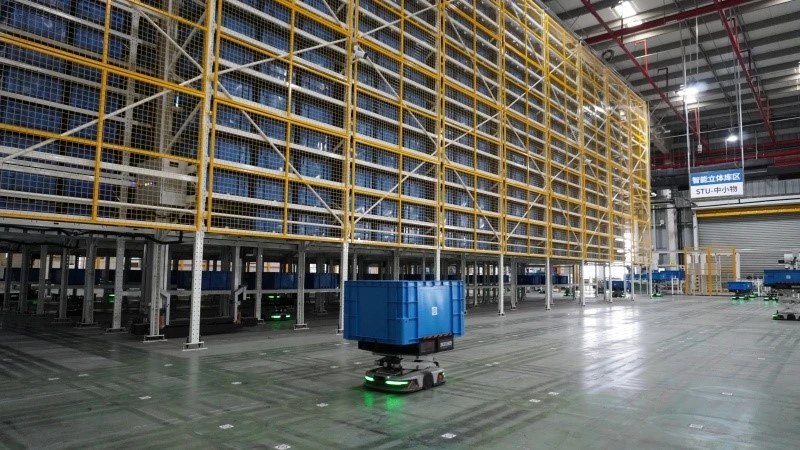
The Mini-FlyBox storage area provides more than 17,000 tote locations and is divided according to two main tote heights.
The H300 tote area uses a 15-level design and provides more than 10,000 locations. The H450 tote area uses an 11-level design and provides more than 7,000 locations.
By designing separate storage sections around actual tote dimensions, the system reduces unused vertical space and improves storage capacity within the available warehouse footprint.
This approach is especially suitable for spare-parts warehouses where different product categories require more than one standard tote height.
Compact Operation in Narrow Aisles
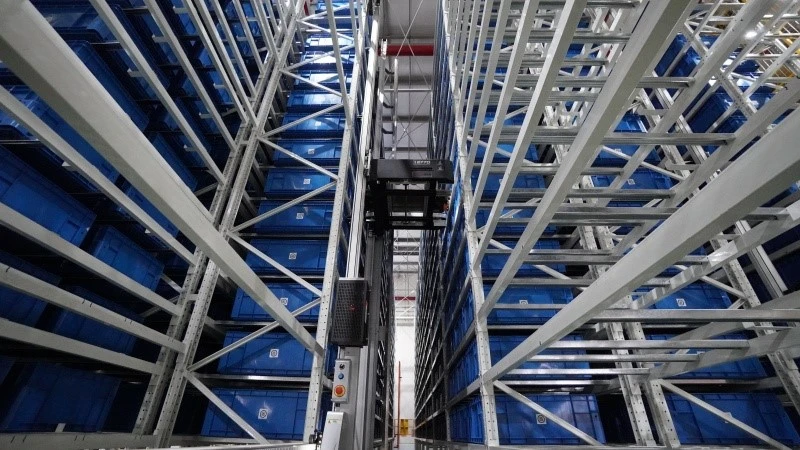
The DELIECN Mini-FlyBox is designed to operate in aisles approximately 1,100 mm wide.
Its compact structure allows the racking system to reduce aisle space and allocate more floor area to storage locations. The robot combines fast travel and lifting functions to reach totes stored at different horizontal positions and rack levels.
Depending on the system configuration, Mini-FlyBox can support loads of up to 50 kg, horizontal travel speeds of up to 3.5 m/s, and lifting speeds of up to 3 m/s.
These characteristics make it suitable for high-SKU warehouses that require both dense storage and frequent tote retrieval.
Goods-to-Person Picking
In a conventional small-parts warehouse, employees move through aisles to locate and pick goods. In the Mini-FlyBox system, the process is reversed.
The WCS releases the order task, the robot retrieves the required tote, and the tote is transferred through the conveyor system to a designated workstation. Operators complete picking at a fixed position instead of repeatedly walking through the warehouse.
After the required items are picked, the tote can be returned automatically to storage or directed to the next process.
This goods-to-person workflow helps reduce walking distance, shorten picking time, and create a more consistent operating rhythm.
High-Frequency Multi-Robot Operation
The project uses 18 DELIECN Mini-FlyBox robots.
Multiple robots can operate in parallel, allowing the WCS to distribute tasks according to robot location, order priority, workstation demand, and equipment status.
The system is designed to support total inbound and outbound throughput of up to 870 order lines per hour under the defined project conditions.
Instead of relying on one central machine, the multi-robot architecture distributes tasks across the storage system. This supports high-frequency order processing and provides greater flexibility when demand changes.
Integration with Conveyors, Workstations, and TOTE AMRs
Mini-FlyBox is not used as an independent storage device.
In the FAW Toyota project, the system integrates with tote conveyors, picking workstations, electronic picking tools, and TOTE AMRs. Retrieved totes can be transported from the automated storage area to picking or downstream processing zones according to the task flow.
The project also uses 54 TOTE AMRs and 24 AGVs to connect different warehouse areas. TOTE AMRs handle frequent lightweight tote movement, while AGVs support other transport tasks across the facility.
This combination connects automated storage with picking, sorting, replenishment, and outbound processes, reducing manual transport between separated work areas.
Digital Inventory and Process Control
The DELIECN WMS manages tote locations, SKU information, inventory status, batches, picking tasks, replenishment, returns, and exception records.
The WCS converts these business tasks into equipment instructions and coordinates Mini-FlyBox robots, conveyors, workstations, and mobile robots.
Each tote movement is recorded in the system, giving the warehouse clearer visibility into where inventory is stored, which task is being executed, and how the order is progressing.
For a warehouse with tens of thousands of SKUs, this digital management capability is as important as robot speed.
Benefits
The Mini-FlyBox AS/RS provides several direct benefits for automotive spare-parts operations.
It increases storage capacity by using narrow aisles and multi-level racking. It reduces operator walking through goods-to-person picking and improves the efficiency of fragmented order processing.
Standardized tote management and system-directed picking also reduce dependence on individual experience and improve order accuracy.
Because robots, conveyors, workstations, and mobile handling equipment operate under unified software control, small-parts storage becomes part of a continuous automated workflow rather than a separate warehouse process.
Together with the other automated systems in the FAW Toyota project, Mini-FlyBox helped support a major reduction in the customer's supply cycle, from eight days to two days.
Conclusion
The FAW Toyota application shows how Mini-FlyBox can address the central challenges of automotive small-parts warehousing: high SKU volume, limited storage space, frequent picking, and complex internal movement.
With more than 17,000 tote locations, two tote-height zones, 18 robots, goods-to-person picking, and WMS/WCS coordination, the system provides a scalable foundation for faster and more accurate spare-parts fulfillment.
When planning a Mini-FlyBox project, companies should evaluate tote dimensions, SKU structure, inventory levels, picking frequency, workstation requirements, warehouse height, and target throughput.
Looking to automate a high-SKU small-parts warehouse? Share your requirements with DELIECN.


