

A Tote Four-Way Shuttle Robot is widely used in automated storage and retrieval systems for totes, bins, cartons, and small or medium-sized goods. It can move forward, backward, left, and right inside the racking system, helping warehouses improve storage density, picking efficiency, and inventory accuracy.
However, choosing a tote four-way shuttle robot manufacturer is not just about comparing robot speed or price. A successful ASRS project depends on the complete system, including shuttle robots, racking, lifters, conveyors, workstations, WMS/WCS software.
For end users and system integrators, the right supplier should be a reliable core equipment partner, not only a robot seller.
1. Evaluate Robot Performance
Robot performance is the foundation of a tote shuttle ASRS.
Key factors include:
- Travel speed
- Positioning accuracy
- Load capacity
- Acceleration and braking stability
- Communication reliability
- Safety protection
Advanced tote four-way shuttle robots can reach 5 m/s travel speed, but speed alone does not decide system performance. The robot must also provide stable movement, accurate stopping, and reliable tote handling during continuous operation.
For high-frequency picking projects, buyers should focus on real system throughput, not only maximum speed.
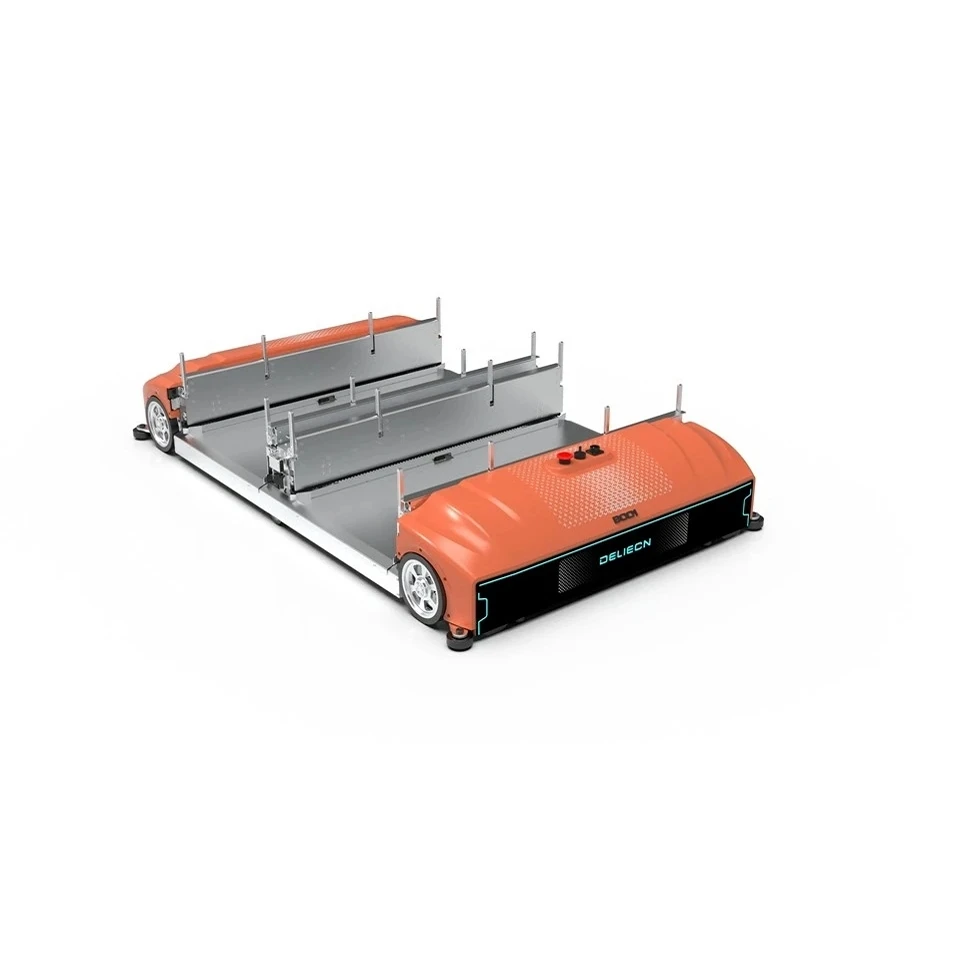
2. Check Tote and Carton Compatibility
Many warehouses handle more than one tote size. Automotive spare parts, electronics, pharmaceuticals, retail, and manufacturing warehouses often store different tote heights, carton sizes, and container types.
This makes adjustable fork design an important evaluation point.
A shuttle robot with adjustable forks can handle different tote or carton widths in the same system, improving storage flexibility and reducing the need for separate storage zones.
Before choosing a supplier, buyers should confirm:
- Supported tote sizes
- Maximum tote weight
- Adjustable fork range
- Compatibility with cartons or mixed containers
- Future adaptability when SKU structure changes
For high-SKU warehouses, container compatibility often determines long-term system value.
3. Consider Dual-Station Design
For warehouses with high order-line demand, single-tote handling may limit throughput.
A dual-station tote four-way shuttle robot can handle two totes in one operating cycle. This helps reduce empty travel, improve shuttle utilization, and support faster goods-to-person picking.
Dual-station design is especially useful for:
- Automotive spare parts warehouses
- Electronics component warehouses
- Pharmaceutical distribution
- Retail and e-commerce fulfillment
- Manufacturing line-side storage
Buyers should evaluate whether the supplier can provide both single-station and dual-station options based on actual throughput needs.
4. Review WMS/WCS Integration Capability
A tote shuttle ASRS is highly dependent on software.
The WMS manages inventory, order rules, batches, storage locations, and picking logic. The WCS controls shuttle robots, lifters, conveyors, workstations, and task execution.
If WMS/WCS integration is weak, even a high-speed robot may fail to achieve expected throughput.
A qualified manufacturer should support:
- Shuttle dispatching
- Tote location allocation
- Goods-to-person task flow
- Lifter and conveyor coordination
- Real-time equipment monitoring
- Alarm management
- ERP/MES/OMS/WMS interface integration
- API-based data exchange
For system integrators, open interface capability is especially important. The shuttle system should be able to connect with the integrator's software platform or the end customer's existing system.
5.Check Project Experience
Project experience helps verify whether the supplier can handle real warehouse challenges.
A manufacturer with practical ASRS experience understands SKU dispersion, peak order pressure, tote standardization, workstation balance, system bottlenecks, and maintenance needs.
Before making a decision, buyers should ask whether the supplier has delivered similar projects with comparable SKU quantity, tote volume, warehouse height, and throughput requirements.
6. Confirm Manufacturing and Service Capability
Long-term reliability depends on manufacturing quality and service support.
A strong manufacturer should have stable R&D, production, quality inspection, factory testing, spare parts support, and technical service capability.
Important questions include:
- Are core components self-developed or controlled?
- Is factory testing performed before shipment?
- Are spare parts available long term?
- Can remote technical support be provided?
- Are maintenance manuals and electrical documents complete?
- Can the supplier support overseas or integrator-led projects?
For ASRS projects, after-sales support is part of the system value.
FAQ
1. What is a tote four-way shuttle robot?
It is an automated robot used in tote-based ASRS systems to store and retrieve totes, bins, cartons, or small containers inside high-density racking.
2. Is robot speed the most important factor?
No. Speed is important, but final throughput also depends on lifters, conveyors, workstations, order structure, and WMS/WCS scheduling.
3. Why is adjustable fork design useful?
Adjustable forks allow the robot to handle different tote or carton sizes, improving flexibility for mixed-SKU warehouses.
4. What is the advantage of dual-station design?
Dual-station shuttle robots can handle two totes in one cycle, reducing empty travel and improving throughput in high-frequency picking scenarios.
5. Can tote shuttle robots work with a system integrator's software?
Yes, if the manufacturer provides stable WCS or API interface support. This should be confirmed before project design.
Conclusion
Choosing a tote four-way shuttle robot manufacturer should not be based only on price or robot speed. Buyers should evaluate robot performance, tote compatibility, dual-station capability, WMS/WCS integration, system support, project experience, manufacturing quality, and after-sales service.
For end users, this means a more reliable ASRS system. For system integrators, it means a stronger core equipment partner who can support project design, software connection, commissioning, and long-term operation.
A well-designed tote four-way shuttle ASRS can improve storage density, reduce manual walking, support goods-to-person picking, and improve inventory accuracy for high-SKU warehouses.
Follow DELIECN on LinkedIn for more warehouse automation insights, project updates, and ASRS solution guides.


