Why Food Cold Storage Requires a Different Warehouse Strategy
Food cold storage is not simply a normal warehouse operating at a lower temperature.
Refrigerated space is expensive to build and operate. Products must be managed by batch, production date, and outbound priority. At the same time, frozen-food warehouses often face seasonal production peaks, concentrated outbound demand, and limited availability of personnel willing to work in low-temperature areas.
For these reasons, warehouse performance depends on more than storage capacity. A practical food cold storage system must balance space utilization, stable pallet movement, inventory rotation, traceability, energy consumption, and long-term equipment reliability.
A pallet four-way shuttle ASRS is particularly suitable for food warehouses that handle standardized pallet loads and require high-density, multi-level storage.
Increasing Capacity Without Expanding the Footprint
Expanding a frozen warehouse means adding insulation, refrigeration equipment, fire protection, and energy consumption. In many projects, the more economical approach is to improve the use of the existing refrigerated volume.
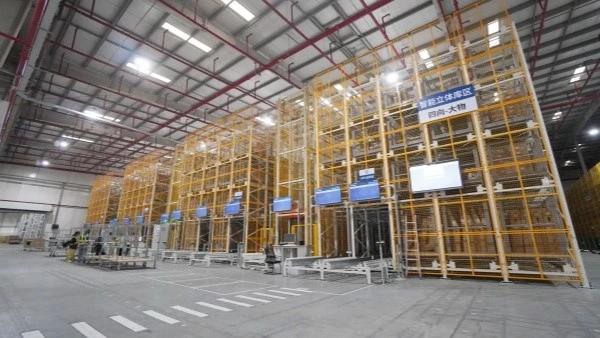
A pallet four-way shuttle system reduces the number of forklift aisles inside the storage area. Pallets are stored in deep lanes across multiple rack levels, while shuttle robots move along the internal rail network and pallet lifters complete vertical transfers.
The storage benefit does not come simply from placing pallets closer together. It comes from redesigning the entire layout around pallet dimensions, building height, rack depth, product turnover, and inbound and outbound processes.
This allows more of the refrigerated building volume to be used for actual inventory rather than vehicle aisles and manual operating space.
Supporting Stable Pallet Flow During Peak Periods
Food production and distribution are rarely uniform throughout the year. Meat processing, frozen food, prepared food, dairy products, and seasonal products may all create concentrated inbound or outbound peaks.
A four-way shuttle robot can serve multiple storage lanes on the same level rather than remaining assigned to one fixed lane. Multiple robots can also operate in parallel under WCS coordination.
When order volume rises, the system allocates tasks according to robot location, route availability, pallet lifter status, and outbound priority. This makes it easier to adjust system capacity than in a layout where each aisle depends on one dedicated handling device.
Actual throughput, however, depends on the complete system. Shuttle speed, robot quantity, pallet lifters, conveyors and loading capacity must be evaluated together.

Improving FIFO and Inventory Traceability
Food warehouses often need to manage products according to production date, batch, and customer requirements.
The WMS records pallet information, inventory status, storage location, batch data, and inbound time. Based on the defined operating rules, it can prioritize the appropriate pallets for outbound tasks.
The WCS then coordinates the shuttle robots, lifters, conveyors, and transfer equipment to complete the physical movement.
This creates a traceable process from receiving and storage to retrieval and outbound delivery. Warehouse managers can see where each pallet is located, when it entered storage, and which task moved it.
For food cold-chain operations, this level of visibility is essential for inventory control and product traceability.
Reducing Manual Work Inside Low-Temperature Areas
Manual forklift operation in a frozen warehouse creates several challenges. Personnel are exposed to low temperatures, vehicle movements increase safety-management requirements, and frequent door opening can affect refrigeration efficiency.
In a shuttle ASRS, the internal storage and retrieval process is automated. Employees mainly work at designated receiving, inspection, picking, and outbound stations rather than repeatedly entering deep storage aisles.
This reduces manual travel inside the cold room and makes operating processes more predictable.
Automation does not eliminate the need for warehouse personnel. Their work shifts toward task management, inbound inspection, exception handling, equipment maintenance, and inventory control.
Equipment Designed for –25°C Operation
A standard shuttle robot should not simply be placed in a frozen warehouse without a low-temperature design.
DELIECN cold-storage pallet four-way shuttle robots are developed for food cold-chain and other low-temperature applications. They can operate continuously and stably in environments down to approximately –25°C.
The complete electrical system uses a low-temperature protection design. Cold-resistant batteries help maintain power stability under prolonged low-temperature operation, where normal batteries may experience faster capacity loss and unstable charging performance.
The robot also uses a lightweight mechanical structure. Reducing the vehicle's own weight lowers the energy required for acceleration, travel, braking, and direction changes while maintaining the required load capacity and structural strength.
Low-temperature projects must also consider humidity, condensation, defrosting, lubrication, cables, seals, sensors, and transitions between temperature zones.

Case study:Ruideli Food Cold Storage Project
Ruideli Food is a modern agricultural and food-processing enterprise with an annual lamb-processing capacity of more than 5,000 tons.
As production capacity increased, the company needed to improve frozen-product storage without relying on further floor-area expansion. Its main requirements included high-density storage, reduced manual work inside the freezer, accurate inventory management, and full-process traceability.
DELIECN developed a –25°C pallet four-way shuttle ASRS for the project.
The approximately 2,400 m² automated cold warehouse uses cold-storage pallet four-way shuttle robots, pallet lifters, chain and roller conveyors, high-density racking, and WMS/WCS software.
The system provides approximately 3,484 pallet locations within a warehouse height of nearly 10 metres.
What Should Be Evaluated Before Selecting a Shuttle System?
The Ruideli project shows that a pallet four-way shuttle system can create significant value in food cold storage, but the same configuration cannot be copied directly into every warehouse.
Before developing a solution, the project team should evaluate pallet dimensions, maximum load, SKU and batch structure, average storage period, daily inbound and outbound volume, seasonal peaks, building height, storage temperature, fire-protection requirements, and ERP or WMS interfaces.
The design should also consider pallet inspection, freezer-door locations, outbound staging,maintenance access, and future expansion.
For warehouses dominated by full-pallet storage and retrieval, the four-way shuttle system can provide clear advantages. Facilities mainly handling piece picking, short-term cross-docking, or highly irregular load units may require additional storage and handling technologies.
Working with DELIECN on Cold Storage Projects
DELIECN works with integrators to support food cold-chain automation projects.
DELIECN can provide pallet shuttle robots, lifters, conveyors, WMS/WCS software, technical documentation, factory testing, commissioning support, training, and spare parts.
This cooperation model allows the local integrator to maintain its customer and project role while gaining access to cold-storage-ready ASRS equipment and engineering support.
Conclusion
The main value of a pallet four-way shuttle system in food cold storage is not simply higher robot speed.
It creates value by increasing refrigerated storage capacity, supporting batch and FIFO management, reducing manual cold-room work, improving pallet-flow stability, and connecting inventory data with production and outbound operations.
The Ruideli project demonstrates how a 2,400 m² automated cold warehouse can provide approximately 3,484 pallet locations, improve space utilization by about three times, increase operating efficiency by more than 60%, and achieve 99.99% inventory accuracy.
Developing a food cold storage project? Share the warehouse temperature, pallet specifications, storage capacity, throughput targets, and preferred cooperation model with DELIECN. Our engineering team can work with your team to evaluate a practical cold-storage ASRS solution.