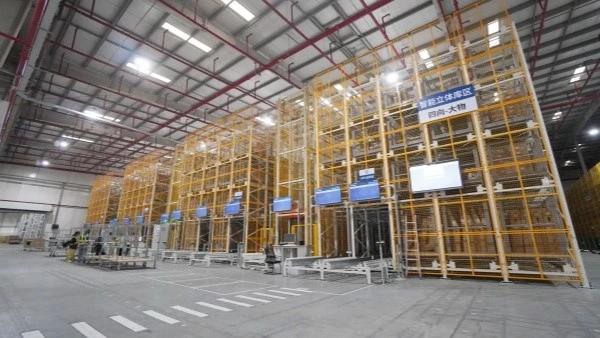
Pallet shuttle robot racking is a high-density automated storage system that integrates shuttle robots, racking, lifters, conveyors, and warehouse control software.
The shuttle robot travels along rails inside the racking system to transport pallets between storage locations and transfer points. Four-way shuttle robots can move both longitudinally and laterally, allowing one robot to serve multiple storage lanes on the same level. Vertical movement is completed through pallet lifters.
By reducing internal operating aisles and using multi-level, deep-lane storage, the system can increase pallet capacity within a limited warehouse footprint. It is widely applied in manufacturing, food and beverage, automotive parts, chemical, cold-chain, and other pallet-storage environments.
1. Core Equipment Development and Manufacturing
The first consideration is whether the manufacturer has independent control over the core equipment.
A pallet shuttle system involves more than the shuttle robot itself. The robot must coordinate accurately with racking rails, pallet lifters, conveyors, and control software.
A manufacturer with in-house research, engineering, and production capabilities can respond more effectively when a project requires changes to pallet dimensions, rack layouts, operating temperatures, or system capacity.
System integrators should assess whether the manufacturer can provide:
- Pallet four-way and two-way shuttle robots
- Pallet lifters and conveyors
- Compatible racking interfaces
- WMS/WCS
- Spare parts and lifecycle support
2. Product Performance Must Match the Application
Equipment specifications should be evaluated in relation to the actual project rather than as isolated numbers.
The standard DELIECN pallet four-way shuttle robot supports pallet loads of up to 1,500 kg, speeds of up to 120 m/min, and positioning accuracy of approximately ±2 mm, depending on the project configuration.
However, suitable equipment selection also requires an analysis of:
- Pallet dimensions
- Maximum load
- Daily inbound and outbound volume
- Peak task requirements
- Operating hours and environment
A reliable manufacturer should help the integrator convert customer data into a technically practical equipment configuration instead of recommending the same model for every warehouse.
3. Customization for Different Warehouse Conditions
Pallet shuttle projects are rarely completely standardized.
Existing buildings may have limited height, irregular column spacing, fire-protection requirements, or narrow equipment access. Production warehouses may also need to connect with production lines.
The equipment partner should therefore be able to adapt the shuttle system to the actual project conditions.
The purpose of customization is not to add unnecessary complexity. It is to ensure that the core equipment can be integrated into the overall solution developed by the local system integrator.

4. Open and Flexible Software Integration
Software cooperation is one of the most important issues in an international integration project.
Some system integrators prefer to use their own WMS or WCS, while others require the equipment manufacturer to provide part or all of the software platform. The cooperation model should therefore remain flexible.DELIECN develops WMS and WCS software and can provide different levels of software cooperation according to the project scope. This may include complete software supply, equipment-level control, API integration, communication protocol support, or joint commissioning with the integrator's software team.
Clear responsibility boundaries, interface documents, alarm codes, data fields, and testing procedures should be confirmed before implementation.
5. Engineering Support During Project Development
Integrators need more than a quotation and equipment catalogue. They need timely engineering support throughout project development.
During the early stage, the equipment manufacturer may need to assist with capacity calculations, equipment quantities, lift configuration, throughput simulation, and technical risk evaluation.
After project confirmation, support normally extends to:
- Detailed equipment design
- Interface confirmation
- Racking coordination
- Factory testing
- Installation guidance
- Software integration
- On-site or remote commissioning
- Operator and maintenance training
A responsive technical team can help the integrator shorten the proposal cycle and reduce design changes during project delivery.
6. Adaptability to Special Environments
The operating environment directly affects shuttle robot configuration.
For cold-storage applications, DELIECN can provide pallet shuttle robots designed for continuous operation at temperatures down to approximately –25°C.
Project-specific solutions can also be developed for dusty facilities or appropriately assessed explosion-risk environments. These applications require corresponding component selection, electrical protection, materials, communication methods, and safety design.
System integrators should provide accurate environmental data during the planning stage rather than treating special conditions as a later modification.
7. Quality Control and Factory Testing
A pallet shuttle robot is part of a complete automated system. Before shipment, the manufacturer should complete structured inspection and testing covering mechanical assembly, electrical functions, positioning, communication, load handling, alarms, and interface logic.
For complex projects, factory integration testing can be used to verify communication between shuttle robots, liftERs, conveyors, and control software before equipment arrives on site.
8. Delivery, Spare Parts, and Technical Support
International projects require clear planning for production lead time, shipping, installation, commissioning, and spare parts.
The equipment manufacturer should provide a project delivery schedule and identify the technical information required from both parties at each stage.
Spare-parts planning is also important. Integrators should confirm the recommended spare-parts list, component lead times, replacement procedures, and technical support channels before project handover.
DELIECN supports overseas partners through remote technical assistance, commissioning guidance, technical training, spare-parts supply, and subsequent system expansion. The service scope can be defined according to the partner's local engineering and after-sales capabilities.
Why Work with DELIECN?
DELIECN provides pallet shuttle and software support for overseas warehouse automation partners.
Its product portfolio includes pallet four-way shuttle robots, tote shuttle robots, Mini-FlyBox, pallet and miniload stacker cranes, lifters, conveyors, WMS, WCS.
Approximately 90% of DELIECN's core software and hardware is developed or manufactured in-house. This allows its engineering team to support customized interfaces, project-specific configurations, and coordinated testing across different equipment types.
For overseas partners, the value is not limited to purchasing one shuttle robot. It lies in gaining access to a complete core-equipment platform that can support different ASRS projects as local market opportunities develop.
Conclusion
Selecting a pallet shuttle robot manufacturer should not be based only on equipment price.
System integrators should evaluate core product capability, project customization, software openness, engineering cooperation, environmental adaptability, quality control, delivery support, and spare-parts availability.
A reliable equipment partner should strengthen the integrator's ability to win and deliver projects.
Looking for a pallet shuttle robot and ASRS equipment partner? Contact DELIECN .