A Tote Shuttle Robot Alone Does Not Deliver a Successful ASRS Project
When evaluating a tote shuttle robot supplier, many buyers first look at robot speed, load capacity, or positioning accuracy. These parameters matter, but they do not decide whether an ASRS project can be delivered successfully.
A tote shuttle robot is only one part of the system. A real project also depends on racking design, tote lifters, conveyors, workstations, safety control, WMS/WCS software, API interfaces, installation, commissioning, and after-sales support.
For automation project partners, the real question is not simply: How fast is the robot?
The more important question is: Can this supplier support the whole project from equipment matching to stable operation?
The Main Risk Is System Coordination
In a tote shuttle ASRS, every part of the system affects the final result.
The shuttle robot retrieves totes inside the racking system. The tote lifter moves totes between levels. Conveyors send totes to picking or replenishment stations. WMS manages inventory and order logic. WCS coordinates the real-time movement of robots, lifters, conveyors, and workstations.
If these parts are supplied, designed, or controlled separately without strong coordination, project risk increases. Common problems include unstable handover points, unclear interface responsibilities, commissioning delays, software communication issues, and throughput that does not match the original design.
This is why choosing a supplier with only one strong product is not enough. For ASRS projects, the supplier's full-system capability is often more important than a single product parameter.
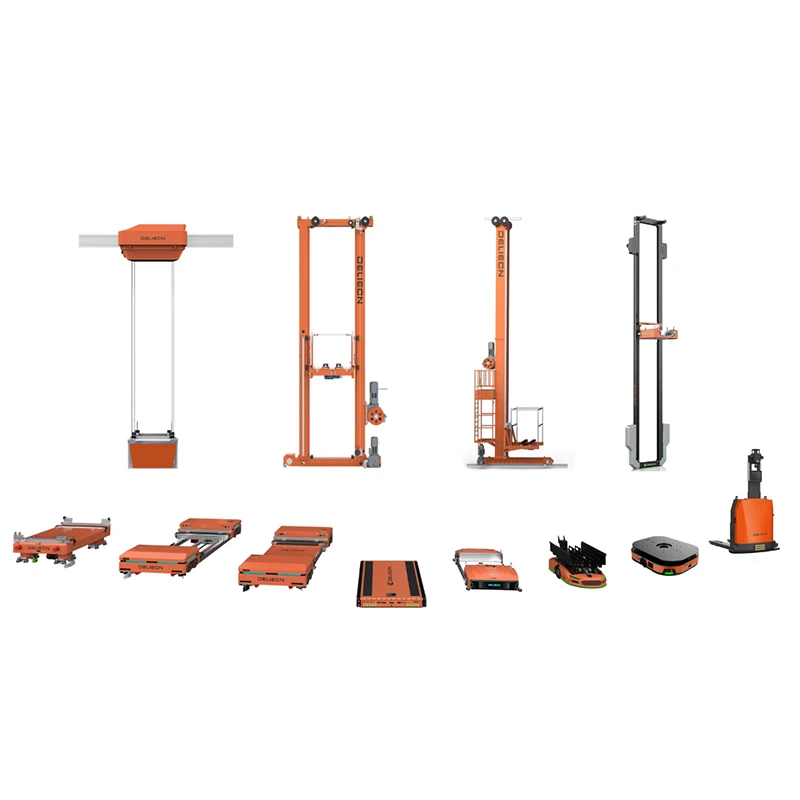
Why Full Product Capability Matters
A reliable tote shuttle robot supplier should understand how the robot works inside a complete automated storage system.
For project partners, this means the supplier should be able to support not only the shuttle robot itself, but also the connected equipment and control logic around it. When the supplier has in-house capability for shuttle robots, racking, lifters, conveyors, WMS/WCS software, and API interfaces, the project becomes easier to coordinate.
This reduces the risk of mismatched equipment, repeated communication between multiple vendors, unclear technical boundaries, and delayed troubleshooting.
In practical ASRS delivery, full product capability helps answer critical questions earlier: Can the shuttle hand over totes smoothly to the lifter? Can the conveyor rhythm match workstation demand? Can WCS dispatch tasks without creating bottlenecks? Can system alarms, equipment status, and task data be visible in real time? Can future expansion be planned from the beginning?
These are the questions that decide whether a tote shuttle ASRS can run reliably after go-live.
What Automation Project Partners Should Look For
A strong supplier should bring more than hardware.
The first thing to evaluate is whether the supplier has real project engineering capability. A product sheet can show speed and load, but project engineering proves whether the system can meet storage capacity, peak order demand, workstation rhythm, and future expansion needs.
The second point is software openness. ASRS projects often need to connect with the customer's ERP, MES, or other business systems. A supplier with self-developed WMS/WCS and API capability can usually provide clearer communication logic, faster troubleshooting, and better project adaptability.
The third point is manufacturing control. If core equipment is self-developed and self-manufactured, the supplier can better control quality, delivery schedule, spare parts, and technical upgrades. This is especially important for overseas projects or partner-led delivery, where response speed directly affect project progress.
DELIECN's Advantage: Full-System In-House Capability
DELIECN is not positioned as a single robot supplier. It provides a full range of ASRS core equipment and software support, including tote shuttle robots, pallet shuttle robots, stacker cranes, tote lifters, conveyors, ASRS racking, WMS/WCS software, API interface support, and 3D visualization.
With around 90% of core hardware and software developed and manufactured in-house, DELIECN can support project partners with more consistent equipment matching, clearer interface control, and more efficient project communication.
This matters because an ASRS project is not delivered by one machine. It is delivered by the coordination of multiple machines, control systems, software logic, and on-site execution.
For tote shuttle ASRS projects, DELIECN can support partners from solution planning and equipment selection to interface coordination, commissioning support, spare parts planning, and long-term technical service.
The Right Supplier Should Reduce Project Uncertainty
A good tote shuttle robot supplier should make the project easier to deliver.
That means the supplier should help clarify system layout, tote specifications, storage capacity, shuttle quantity, lifter configuration, conveyor connection, workstation demand, software interface requirements, and maintenance planning before the project moves into implementation.
The value of a supplier is not only in providing equipment. It is in helping project partners reduce uncertainty before it becomes cost, delay, or after-sales pressure.
For high-SKU warehouses, e-commerce fulfillment, automotive spare parts, electronics, pharmaceuticals, retail distribution, and manufacturing line-side storage, this project-level support can be the difference between a system that looks good in design and a system that performs well in daily operation.
Conclusion
Choosing a tote shuttle robot supplier should not be based only on robot speed or price.
A successful ASRS project requires reliable shuttle robots, matched racking, efficient lifters, stable conveyors, intelligent WMS/WCS coordination, open interfaces, manufacturing control, and long-term service support.
For automation project partners, the right supplier is the one who can support the whole system, not just provide one piece of equipment.
DELIECN's full-product in-house capability helps partners reduce interface risk, improve project coordination, and deliver more reliable tote shuttle ASRS solutions for end users.
Follow DELIECN on LinkedIn for more warehouse automation insights, project updates, and ASRS solution guides.