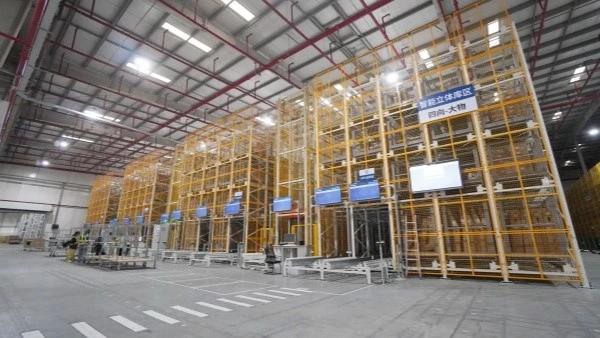
A rack shuttle can operate in environments ranging from approximately –25°C to 45°C, depending on the equipment configuration and actual operating conditions.
In this article, rack shuttle refers to a pallet shuttle robot that travels on rails inside a racking system to complete pallet storage and retrieval.
One standard rack shuttle cannot cover the entire temperature range without configuration changes. A robot operating in an ambient warehouse and one running continuously in a –25°C freezer require different batteries, electrical protection and charging strategies.
The warehouse's normal operating temperature should therefore be confirmed before equipment selection and manufacturing.
Standard Rack Shuttle vs. Cold-Storage Rack Shuttle
A standard rack shuttle is designed mainly for ambient manufacturing, beverage, automotive parts, and logistics warehouses.
A cold-storage rack shuttle is developed for refrigerated and frozen warehouses. Its low-temperature capability is not achieved by changing only the battery. The electrical and mechanical systems must be adapted as a complete unit.
| Configuration | Standard Rack Shuttle | Cold-Storage Rack Shuttle |
|---|---|---|
| Application | Ambient warehouses | Refrigerated and frozen warehouses |
| Operating conditions | Conventional warehouse temperatures | Down to approximately –25°C |
| Battery | Standard battery configuration | Low-temperature-resistant battery |
| Electrical system | Standard industrial components | Low-temperature protection design |
| Charging | Conventional charging strategy | Adapted to low-temperature battery performance |
The correct version should be selected according to the continuous operating environment rather than an occasional temperature peak.
How Low Temperature Affects Rack Shuttle Operation
Low temperatures can reduce battery capacity, and increase the mechanical resistance of moving components. A cold-storage rack shuttle therefore requires a low-temperature-resistant battery to maintain a stable power supply. Its electrical system must also support reliable travel, lifting, communication, and positioning under prolonged low-temperature operation.
Mechanical design is equally important. A lightweight rack shuttle requires less energy during travel, acceleration, braking, and pallet lifting. This helps reduce energy consumption and maintain operating efficiency inside refrigerated warehouses.
The low-temperature design should extend beyond the shuttle itself. Pallet lifters, conveyors, charging equipment, communication components, and transfer stations must also match the same warehouse environment.
Temperature Is Not the Only Environmental Factor
Two warehouses operating at the same temperature may still require different rack shuttle configurations.
Cold-storage project planning should also consider humidity, condensation, defrosting, ice formation, and movement between different temperature zones.
The project team should also confirm whether the rack shuttle remains in one temperature zone or moves between refrigerated and ambient areas. Cross-temperature operation may require additional protection and operating controls.

Which Warehouses Need a Cold-Storage Rack Shuttle?
A cold-storage rack shuttle is commonly used in:
- Frozen food warehouses
- Meat and seafood storage
- Dairy and prepared-food warehouses
- Temperature-controlled raw-material storage
- Other low-temperature pallet ASRS projects
A chilled warehouse operating slightly above freezing and a frozen warehouse operating at –25°C do not require the same equipment configuration.
The required version should be selected according to the normal temperature, minimum temperature, operating duration, pallet throughput, and charging conditions.
Information Required Before Selecting a Rack Shuttle
Temperature alone is not enough to determine the correct rack shuttle configuration.
The equipment manufacturer should receive:
- Normal, minimum, and maximum warehouse temperatures
- Pallet dimensions and maximum load
- Required pallet locations
- Daily and peak throughput
- Continuous operating hours
- Humidity and defrosting conditions
- Rack layout and maintenance access
These details determine the battery, electrical system, materials, and control strategy required for stable operation.
Rack Shuttle Solutions for Different Temperatures
Rack shuttle systems can be configured for both ambient and cold-storage warehouses.
For projects operating down to approximately –25°C, DELIECN can provide pallet two-way and four-way rack shuttle solutions incorporating low-temperature electrical protection, cold-resistant batteries, lightweight mechanical design, and project-specific charging arrangements.
The complete solution can also include pallet lifters, conveyors, racking interfaces, WMS/WCS software, factory testing, commissioning assistance, and spare-parts support.
Conclusion
A rack shuttle can operate within a temperature range of approximately –25°C to 45°C, but different environments require different configurations.
Standard rack shuttles are designed for ambient warehouses. Cold-storage rack shuttles use dedicated batteries, low-temperature electrical protection, and adapted materials to support stable operation in refrigerated and frozen environments.
Planning a rack shuttle project? Contact DELIECN.