Four days at CeMAT 2026. What stayed with us afterwards was four questions from four buyers, and not one of them asked how fast the vehicles run.
A buyer from Thailand opened with gas explosion protection. He wanted to know whether our explosion-proof pallet shuttle could work in his building, and then where the international certification actually stops. A buyer from Korea barely looked at the hardware. He spent the conversation on Mini-FlyBox scheduling, asking whether it would talk to his ERP. A machinery maker from Japan went into delivery detail and lead time. A pallet manufacturer from Brazil wanted to talk about working together.
Four countries, four questions, one theme. Nobody was sizing equipment. They were checking whether it could enter a procurement system, speak to existing software, and arrive on a date that survives a project plan.
Two or three years ago the opening line at a booth was throughput, or price per pallet position. This year it was certification, interface, delivery. That shift records the state of the category better than any launch on the floor.
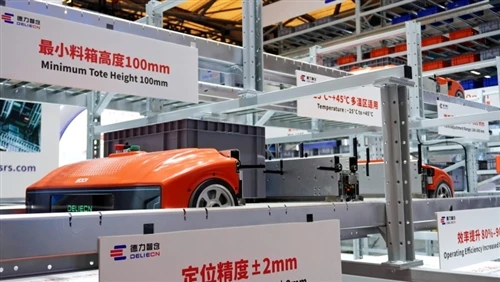
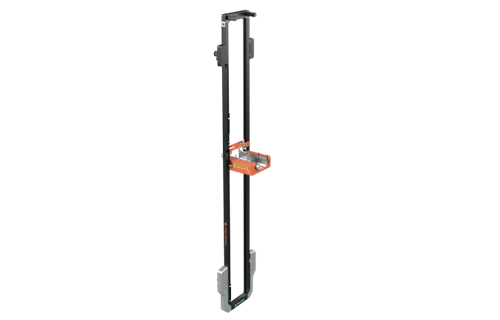
And that shift is the backdrop for the product we brought: a dual-station tote shuttle, pitched in one sentence as one vehicle doing the work of two. What that sentence describes is a cost that rarely appears in a quotation.
The Tote Question Moved From Storage to Turnover
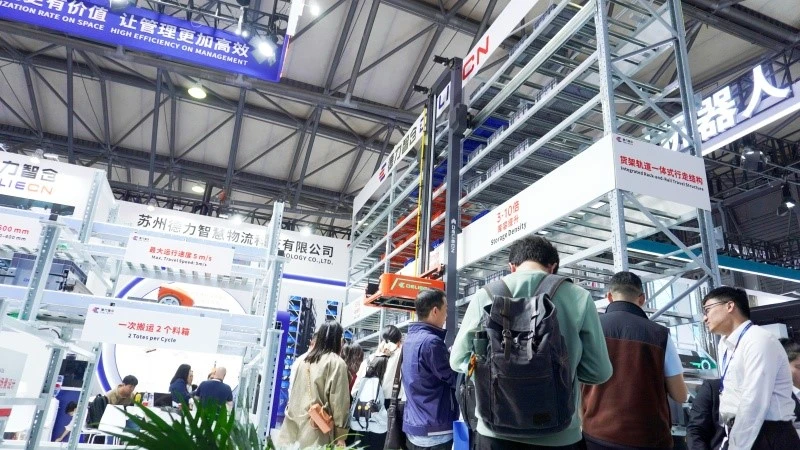
Mini-FlyBox-class systems showed up at more than one booth this year. Competitors sharing a floor is not the interesting part. What the overlap says about the stage of the category is. Tote-level automation has left the concept phase and entered the delivery phase.
The first half of that phase was about storage. Get the density up, make goods-to-person work, stop sending pickers down the aisle. Most of the serious suppliers have answers to those questions now, and the gaps between them have narrowed.
The pressure moved to the other end: turnover. SKU counts keep rising, batches keep shrinking, orders keep fragmenting, and slots get rearranged far more often per year than they did a decade ago. Vehicle speed stopped being the binding constraint. What hurts is what happens to the system when the slotting changes.
So the real selection split has nothing to do with the vehicle. It sits in the order profile. A whole-carton warehouse and a piece-picking warehouse both call their solution goods-to-person, and underneath they need two different systems. Putting those two customers in the same comparison table is the most common mistake we see in tote projects.
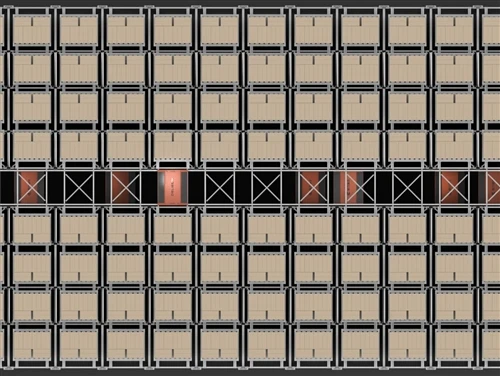
That's also why Mini-FlyBox keeps appearing on show floors. It packs small parts, many SKUs and high frequency into a unit a customer can cost on its own. You don't have to bet the whole building. You can carve out one zone, run it, and decide.
Where the Second Station Actually Pays Back
The expensive motion in distribution isn't storing and it isn't picking. It's re-slotting.
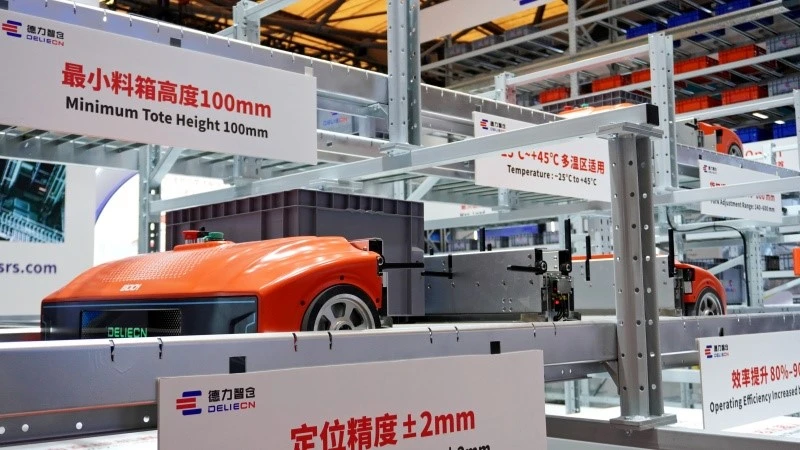
DELIECN's dual-station tote shuttle, shown for the first time at CeMAT, was designed around that motion.
Run the arithmetic once. One tote per trip means ten thousand totes moved is twenty thousand trips, one to collect and one to place. Not one of those trips creates inventory value. They consume aisle time and electricity.
A dual-station shuttle carries two totes per trip and halves the trip count. But "twice as fast" is the wrong claim, and speed isn't where the money is.
Aisles are shared. Every minute a vehicle spends inside one is a minute every other vehicle spends queuing. So the return on the second station scales with congestion. In a busy building it's worth a lot. In a quiet building the second position sits empty for most of the shift.
Which gives buyers a better question than "how much faster". Ask what vehicle utilisation looks like in your peak hour. High utilisation makes the second station necessary. Low utilisation makes it an oversized vehicle that also eats aisle width.
Then there's the lifter, and this is the part that rarely gets its own line in a proposal. In tote systems the lifter usually bottlenecks before the fleet does. Two totes per interface cycle is capacity added without buying another lifter. In our experience that effect on real output is often larger than any difference in travel speed.
When the Second Station Is One Station Too Many
If the profile is full-pallet in and out, few SKUs and slow turnover, the second position idles for much of the day. You'll still pay for the longer body and the aisle it occupies.
The test is peak utilisation on your own order data, not what the neighbouring project bought or what looks better on a layout drawing.
Cold Rooms, Thirty Metres, and a Certification Question
The pallet-side launches this year had something in common. They all sat at the edges of the envelope.
Frozen storage is the clearest example. The difficulty was never moving room-temperature equipment into a cold room. Steel behaviour at low temperature has to be re-checked. Seal materials change, sensors need to survive frost, and the defrost window has to miss the inbound peak. Anyone who's commissioned one knows the dominant cost is often the maintenance window rather than the machinery. How long a defrost stops the system decides how many hours a year the system actually runs.
Thirty metres is where the constraint stops being the vehicle. Mast stability, lifter stroke, installation tolerance, fire protection, maintenance access. You can't solve it from a catalogue, so a 30 m installation gets solved per building. The vehicle is the easy part of that conversation.
Explosion protection deserves its own paragraph. DELIECN showed an explosion-proof Pallet Four-Way Shuttle Robot at the show, the first time this category has appeared at CeMAT, and it drew a steady crowd.
Explosion protection gets underestimated from the outside. It isn't a sealed enclosure bolted onto a standard vehicle. Motors, controls, static discharge, surface temperature and energy limitation under fault all get redesigned, and then the whole assembly goes through certification. That's why the Thai buyer asked about certification before price. It's the question of someone who has bought this equipment before.
Four Buyers, Four Questions, One Decision Map
Put the four conversations side by side and they draw a map of how the purchase decision has moved.
The Thai question about gas protection and international certification tells you that chemical and energy warehouses in Southeast Asia are now automating to a standard rather than to a price. A market where buyers pay for compliance is a market that has grown up.
The Korean question about Mini-FlyBox scheduling and ERP tells you the opposite story at the hardware layer. Vehicles are converging. Interfaces are diverging. Whether a fleet can be called cleanly from a customer's WMS, ERP and MES is now a harder barrier than body height, and it's the barrier most suppliers still underestimate.
Brazil and Japan point at something else. A pallet manufacturer looking for a Chinese partner, and a machinery maker asking about delivery detail, both describe a supply chain that is moving from exporting machines to supplying capability that can be integrated locally, audited by an engineering department and scheduled into a project.
The Japanese questions are the ones I keep coming back to. Almost none of them were about sophistication. They were about certainty. Sophistication gets you the meeting. Delivery gets you the contract.
What We Took Away
Attention on smart warehousing is genuinely global now. Four buyers from four countries asking four different questions at one small booth is more direct evidence than any market report.
Demand in China is growing, though it's worth separating new capacity from retrofit. The two want opposite things. A greenfield building can be laid out around the equipment. A retrofit has to negotiate existing clear height, the column grid and a shift that cannot stop. Retrofit is harder, and it exposes whether a supplier has field capability or only a catalogue.
As for us, the recognition from industry experts and end users is welcome. What matters more is the form it took. The questions got specific. When a buyer asks which certification band you hold, how the interface opens, and how you hold a delivery date, that buyer is close to an order. People browsing a show don't ask those.
One vehicle doing the work of two saves trips. What the industry might save along with it is a way of counting. Automation isn't buying more expensive equipment. It's deleting the motions that produce nothing. Density, speed and body thickness are the numbers everyone watches. Output is decided by the motions nobody wants to admit to: the empty run, the wait at the lifter, the re-slot, the defrost.
Next year, the question underneath it will still be there. In your building, which motion costs the most?