When we reviewed this precision manufacturing project, the most important figure was not the warehouse height or the number of storage locations.It was the number of component types.The manufacturer produces electrical connectors, connector assemblies and electromechanical products for rail transportation, communications, industrial equipment, wind power and new energy vehicles. Years of product development had expanded its material range to more than 9,700 SKUs.That level of variety changes the warehouse problem.Small parts may occupy little physical space, but every SKU still needs to be identified, stored and delivered to production at the right time. As the product range grows, adding more shelves creates more locations to search. Adding more operators increases labor capacity but does not make the correct material easier to find.The real question was not how to store more components. It was how to keep 9,700-plus SKUs manageable as production demand continued to change.
Why SKU Growth Made Manual Storage Harder to Scale
In a traditional warehouse, experienced operators often remember where frequently used materials are stored. That works while the number of locations remains manageable.The difficulty appears gradually.Some components are used every day, while others remain in stock for much longer. High-usage materials may occupy several containers. Partial quantities return from production. New product models introduce more specifications, but older parts may still need to remain available.More shelves eventually mean more walking, checking and searching. A delay of several minutes on one task may appear minor, but repeated across multiple production lines, it begins to affect replenishment and production continuity.The warehouse therefore needed to reduce its dependence on location memory without making material handling more complicated.
Using Vertical Space Without Slowing Retrieval
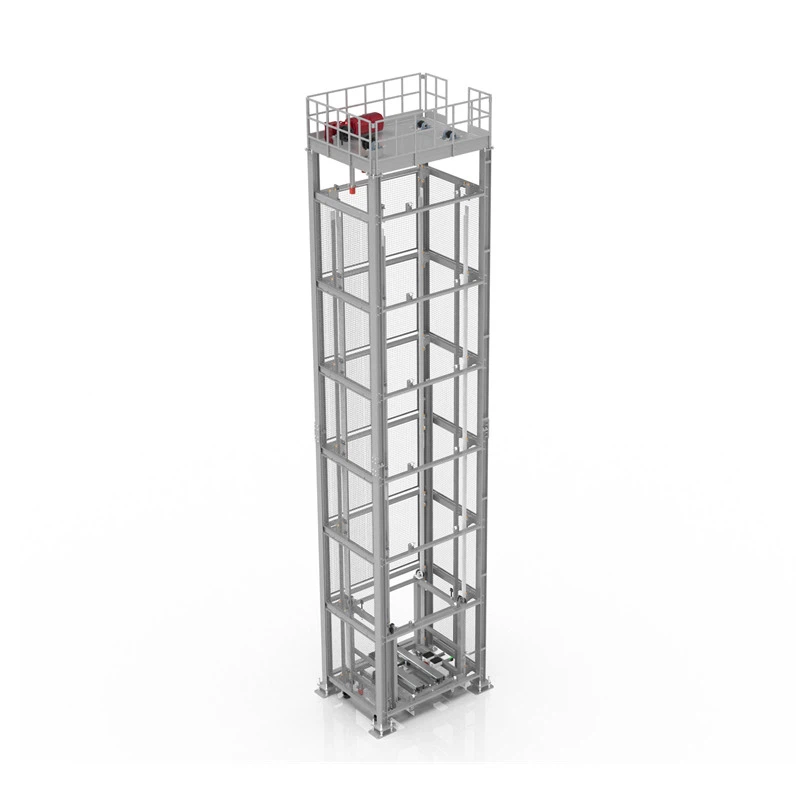
The final design uses a 22.3-meter-high tote four-way shuttle AS/RS with more than 18,700 storage locations.This allowed the manufacturer to increase capacity within the available building footprint rather than continuing to expand shelving horizontally.However, the location count was not planned as a simple one-to-one match with the 9,700 SKUs.Frequently used components may require inventory in several totes. Other materials may occupy changing locations as stock levels rise and fall. The system also needs available positions for newly received goods and materials returned from production.This operating space is important. A warehouse filled to its theoretical maximum may look efficient on paper but leave too little flexibility for daily storage and retrieval.The four-way shuttle configuration allows robots to move between storage lanes and levels rather than remaining permanently assigned to one aisle. WCS can allocate tasks according to robot position, current workload and destination.If one area becomes busy, available robot capacity can be redirected. If one shuttle is unavailable, its unfinished tasks can be assigned to another vehicle rather than making an entire aisle inaccessible.For a high-SKU warehouse, that flexibility can be more valuable than simply maximizing the number of locations.

Throughput Was Based on Production Demand
The project was designed to handle 323 totes per hour.That figure came from the material demand of the production operation, not only from the maximum speed of the shuttle robots.A tote retrieval task passes through several stages. The required inventory must be identified, retrieved from its storage location, transferred between levels and delivered through conveyors or RGVs to the required operating point.If one stage is undersized, increasing the speed or number of shuttles will not improve the complete process. Totes will simply wait at the next interface.The project team therefore planned the shuttle robots, lifters, RGVs, conveyors and work areas as one material route.This becomes especially important when several production lines request components at the same time. The warehouse must prioritize urgent replenishment while continuing to process inbound and return tasks.The 323-tote-per-hour figure reflects the planned performance of that complete route under the project's operating conditions.
Not Every Material Belonged in a Tote
A precision manufacturer rarely handles one completely uniform load type.Small parts are well suited to tote storage, but larger components, outer packages and handling frames may still require pallet storage. Repacking every item into a tote would add handling work and could create containers that do not suit the material.The project therefore combines tote four-way shuttle storage with pallet storage equipment.This is not a limitation of the tote system. It is a deliberate division based on material dimensions, weight and handling requirements.Small components gain the density and retrieval accuracy of automated tote storage. Larger units remain in a format that is more practical for their physical characteristics.The two storage areas are connected through warehouse tasks and material data. Production does not need to know which type of equipment holds an item. It needs the correct material to arrive at the correct point and time.
Replacing Location Memory with System-Directed Tasks
WMS maintains the relationship among material codes, inventory quantities, totes and storage locations. When production requires a component, it identifies the appropriate inventory and generates a warehouse task.WCS then coordinates the shuttles, lifters, RGVs and conveyors that carry out the movement.This separation keeps inventory management and equipment execution clear. WMS determines what should move, while WCS determines how the automated equipment completes the task. The shuttle robots themselves do not connect directly to ERP or MES.Employees are no longer expected to remember thousands of storage locations or search through shelves for every request. Their attention can shift toward exception handling, inventory quality and process supervision.For the manufacturer, this makes warehouse performance less dependent on individual experience while still using people where judgment is most valuable.
What Other Precision Manufacturers Can Learn
The project provides more than 18,700 storage locations and supports 323 totes per hour, but those figures should not be copied directly into another warehouse design.Its broader value lies in the planning logic.The manufacturer first examined SKU quantity, inventory depth and production replenishment demand. It then determined which materials belonged in totes, how much operating space the warehouse required and where the material flow could become constrained.Another facility may need a different configuration. A smaller SKU range could be handled by a miniload system. Heavier or larger materials may remain palletized. A lower building or slower replenishment rhythm may not justify a 22.3-meter shuttle warehouse.Before selecting equipment, precision manufacturers should ask:How quickly is the SKU range growing? How many material requests can production release during peak periods? Which parts genuinely belong in totes? And if one device becomes unavailable, which materials can no longer be reached?In this project, the tote four-way shuttle AS/RS did more than create additional storage locations. It gave the manufacturer a structured way to manage more than 9,700 component types and supply them at a rhythm aligned with production.That is the point at which an automated warehouse begins to support manufacturing rather than simply store its materials.