A manufacturer may have a reliable automated pallet warehouse and still struggle to get the right materials to production on time. The stacker crane can store and retrieve pallets accurately, but if warehouse inventory, production orders, and equipment tasks are managed separately, delays and manual data entry can remain part of daily operations.This is why WMS integration is an important consideration when selecting a single-mast pallet stacker crane.
The answer is yes. A single-mast pallet stacker crane can be integrated with a Warehouse Management System (WMS). However, successful integration depends on more than whether the crane supports a communication protocol. The warehouse management software, equipment control system, material handling interfaces, and existing business systems must work together.
For manufacturers planning a new automated storage and retrieval system (AS/RS) or upgrading an existing warehouse, understanding these connections helps prevent unnecessary integration costs and operational problems.
How Does a Single-Mast Pallet Stacker Crane Work with WMS?
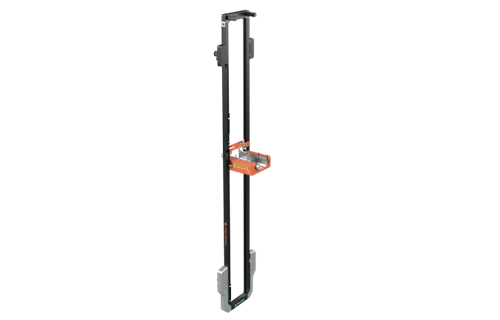
A single-mast pallet stacker crane is an automated storage and retrieval machine that travels along a fixed aisle between racks. Its lifting carriage moves vertically, while a load-handling device transfers pallets between the crane and designated storage locations.The single-mast design uses one main vertical column rather than two. Its suitability depends on load capacity, storage height, structural rigidity, operating speed, and project layout.But regardless of the mechanical structure, a stacker crane cannot manage warehouse orders or inventory records by itself.In a typical automated pallet warehouse, different software and control layers perform different functions.
WMS (Warehouse Management System) manages warehouse operations, including inventory records, storage locations, inbound and outbound orders, stock status, and batch traceability.
WCS (Warehouse Control System) coordinates the execution of warehouse tasks. It schedules the stacker crane and connected equipment, manages transfer sequences, and responds to equipment availability and operating conditions.
PLC and equipment control systems execute machine-level movements, such as travelling, lifting, fork extension, positioning, and safety-related control functions.
The relationship can be summarized as:ERP/MES → WMS → WCS → Equipment Controls → Stacker CraneOperational data and task confirmations flow back through the relevant systems.The exact software architecture depends on the project. Some facilities use an existing third-party WMS, while others implement WMS and WCS together as part of a new automated warehouse.
What Happens During an Automated Pallet Retrieval Task?
Consider a manufacturing warehouse that stores raw materials and finished components in a pallet AS/RS.When production requires a particular material, the MES or ERP may send the requirement to WMS.WMS identifies the material, verifies inventory availability, and releases a retrieval task according to the warehouse's inventory rules.WCS then coordinates the equipment required to complete that task.The stacker crane travels to the assigned location, lifts its load carriage to the required level, and retrieves the pallet. The pallet is transferred to an outbound conveyor or another designated handover point.If the material must be delivered to a production area, additional equipment such as an RGV, conveyor, or Pallet AMR may be involved.Once the required task confirmations are received, WMS updates the corresponding inventory and task records.This process reduces the need for operators to manually enter storage locations or transfer information between separate systems.However, the reliability of the process depends on the physical and digital interfaces being designed together.For example, if an outbound conveyor is occupied, WCS must account for that condition before releasing the next transfer. Otherwise, a fast stacker crane may simply spend more time waiting at the handover point.That is why overall warehouse throughput cannot be determined by crane travel speed alone.
Can a Single-Mast Stacker Crane Connect to an Existing WMS?
In many projects, yes. Replacing the entire warehouse management platform is not always necessary.The first question is whether the existing WMS can exchange the data needed for automated operations.Typical integration requirements include storage location identifiers, pallet or load-unit IDs, inbound and outbound task messages, task status, completion confirmations, and exception information.These messages may be exchanged through APIs, middleware, or other agreed interfaces.The WCS or integration layer must then translate warehouse tasks into executable equipment operations.There is an important distinction here: a PLC communication interface does not, by itself, guarantee compatibility with an existing WMS.The integration team must also confirm how data is mapped, which system controls each process, how errors are reported, and what happens when communication is interrupted.Before approving an integration plan, warehouse operators should clarify several questions:
- Can the existing WMS provide the required task and inventory data?
- Who is responsible for storage location allocation and task priorities?
- How will pallet identification be verified at inbound and outbound points?
- What happens when equipment is unavailable or a pallet fails a dimension check?
- Can completed tasks and exceptions be traced back to the correct inventory records?
- Who maintains the software interfaces after the system goes live?
Answering these questions during the design stage is usually more valuable than choosing equipment based solely on its list of supported protocols.


What Does a Real Manufacturing Project Tell Us?
An automated warehouse project completed by DELIECN for a compressor and pump manufacturer provides a useful example of system-level integration.The Hanbell project uses a Pallet Stacker Crane AS/RS with 2,872 pallet locations. Because the warehouse had only two available crane aisles but needed substantial pallet throughput, the project adopted a configuration with two stacker cranes operating on one rail in each aisle.The equipment arrangement is different from a conventional single-crane installation, but it illustrates why software coordination is essential.WCS coordinates stacker crane operations, task allocation, equipment status, and connected RGV and conveyor movements.The warehouse software also exchanges information with MES and ERP, allowing storage and material handling tasks to respond to actual production requirements.In this project, integration was not simply about sending a retrieval command to a crane. It was about connecting inventory, material preparation, automated transport, and production-side delivery.For buyers evaluating a single-mast pallet stacker crane, the same system-level principle applies, although the equipment configuration and control interfaces must be designed for the selected model.
What Should Be Tested Before the System Goes Live?
Software integration should be verified through actual operating scenarios, not only through a successful communication connection.During commissioning, the project team should test whether inbound and outbound tasks are executed correctly, whether pallet identification matches the inventory records, and whether task confirmations are returned to the appropriate systems.Exception handling is equally important.A reliable commissioning plan should include scenarios involving occupied transfer stations, failed pallet identification, equipment alarms, communication interruptions, and controlled system recovery.The team should also verify task priority management, safety interlocks, and the sequence of operations between stacker cranes, conveyors, and other connected equipment.Performance testing should reflect the project's agreed operating conditions. The relevant indicators may include completed pallet movements per hour, task waiting time, equipment utilization, and inventory transaction accuracy.These results provide a more meaningful basis for acceptance than the theoretical maximum speed of the stacker crane.
Does WMS Integration Make Future Expansion Easier?
Integration can support future warehouse expansion, but it does not make additional equipment automatically compatible.A manufacturer may initially install one stacker crane and later plan to add another aisle, an additional conveyor interface, or automated material transport to production.If the original software architecture has been designed with clear equipment interfaces and capacity planning, expansion can be more manageable.Nevertheless, each change must be assessed for physical layout, equipment control, software licensing, task scheduling, safety requirements, and throughput capacity.A second stacker crane will not necessarily double warehouse output if the inbound conveyor or outbound transfer station is already operating near capacity.For this reason, the integration plan should consider both current requirements and realistic future growth.
Choosing a Single-Mast Pallet Stacker Crane for Your Warehouse
A single-mast pallet stacker crane can be an effective solution for automated pallet storage when its structural design and operating performance match the application.But the purchasing decision should not be based on mast configuration alone.Before selecting the system, manufacturers should confirm pallet dimensions, maximum load weight, warehouse height, required storage capacity, inbound and outbound throughput, existing WMS capabilities, and connections to production or distribution processes.DELIECN develops and integrates Pallet Stacker Crane AS/RS solutions together with racking, conveyors, RGVs, AMRs, and WMS/WCS software.For projects involving an existing WMS, the integration requirements should be reviewed early so that mechanical design, software interfaces, and commissioning responsibilities are agreed before installation.
The main objective is not simply to connect a stacker crane to warehouse software. It is to ensure that the right pallet can be stored, retrieved, tracked, and delivered according to the actual needs of the business.
If you are evaluating a single-mast pallet stacker crane or planning to connect a new AS/RS to an existing WMS, share your warehouse layout, pallet specifications, throughput requirements, and current software environment with the DELIECN team for a project-specific assessment.